Showing posts sorted by date for query sunday school. Sort by relevance Show all posts

Tuesday, December 11, 2018

Bonus Post: We don't go to Nigeria (but we would if we could)

Wheelchairs for Nigeria
Someone recently told me she didn’t want to give her children vaccines because she didn’t think they did any good, and might instead cause harm. She said, “I don’t see how putting a disease in someone can prevent a disease.”

Sadly, she’s not alone these days. There seem to be a growing number of people who believe what a friend of a friend, a former Playboy centerfold, or a leading comic from the '90s have to say about the topic rather than decades of scientific research. It’s sort of depressing.

So here’s some good news: polio has almost been eradicated. Last year there were only 22 reported new cases in the world. Thirty years ago, thousands of people contracted the disease every year in Nigeria, but around that time, Rotary International took an interest in providing vaccines to the nation. In time, the Gates Foundation took up the cause. Is it just a coincidence that the dramatic decline in polio occurred when the vaccines were distributed?

Dr. Ron Rice, a retired Presbyterian pastor, presented this good news to a Sunday School class at West Side Presbyterian Church last Sunday. but there was bad news to go with the good. Though a great deal of charitable giving has been directed toward preventing new cases, little has been done for the crippled victims of the disease. For that matter, little has been done to help Nigerians living with the effects of birth defects, other diseases, and maiming accidents. Wheelchairs for Nigeria, through Beautiful Gate, is doing that very thing. 

The name “Beautiful Gate” comes from the passage in Acts 3 where God used Peter to heal a lame man who waited by a temple gate called “Beautiful.” With a factory employing 65 Nigerians (some of them physically disabled), the ministry manufactures wheelchairs for distribution throughout the country. These wheelchairs are quite different from what you’re probably picturing. They’re more like adult-sized tricycles adapted for pedaling and steering by hand (instead of feet).

Ron and his wife Sharon recently returned from a three-week wheelchair distribution trip to Plateau State in Nigeria. From a base in Jos, the Rices and Ayuba Gufwan, their Nigerian partner, drove to communities up to three hours away to distribute wheelchairs. Ayuba, himself a polio survivor who uses a wheelchair, was honored with presentations in several communities, while Ron, who was made an honorary chief on a recent trip, was able to meet -- in appropriate turban and robes -- with an emir to discuss the project. While at the emir’s palace, Beautiful Gate gave away 50 wheelchairs to members of the community. Many of the local leaders he meets are Muslim. Nigeria (the most populous African nation) is a majority Islamic nation, though a few Nigerian states have a Christian majority.

When Ron meets with Muslim leaders, he doesn't hide his faith in Christ or that most of the money for the wheelchairs comes from churches in the United States. He is respectful of the people he meets with, acknowledging that Islam also calls for concern for the poor and weak. Muslim leaders, he said, are often surprised that Christians are concerned for poor Muslims.

On this trip, Ron and Sharon were also able to visit a state school for the deaf and two different ministries for the blind. At the University of Jos, the 85 blind students in residence were offered a folding white cane or an audio recorder they could use for lectures. Every stop on their trip provided an opportunity to remind people of God’s love for them and His special care for the poor. The main emphasis of their ministry, though, is polio victims. Beautiful Gate distributed 360 chairs in eight different presentations. In every community, more chairs than they could accommodate were needed.

Could you help fill this need? One chair manufactured by Beautiful Gate’s factory costs $150. As you consider charitable giving this Christmas season (and before year’s end), this is certainly a worthy ministry. Click here to learn more.

Wednesday, November 21, 2018

We go to a hallowed place

Dean and Mindy go to the Hallows
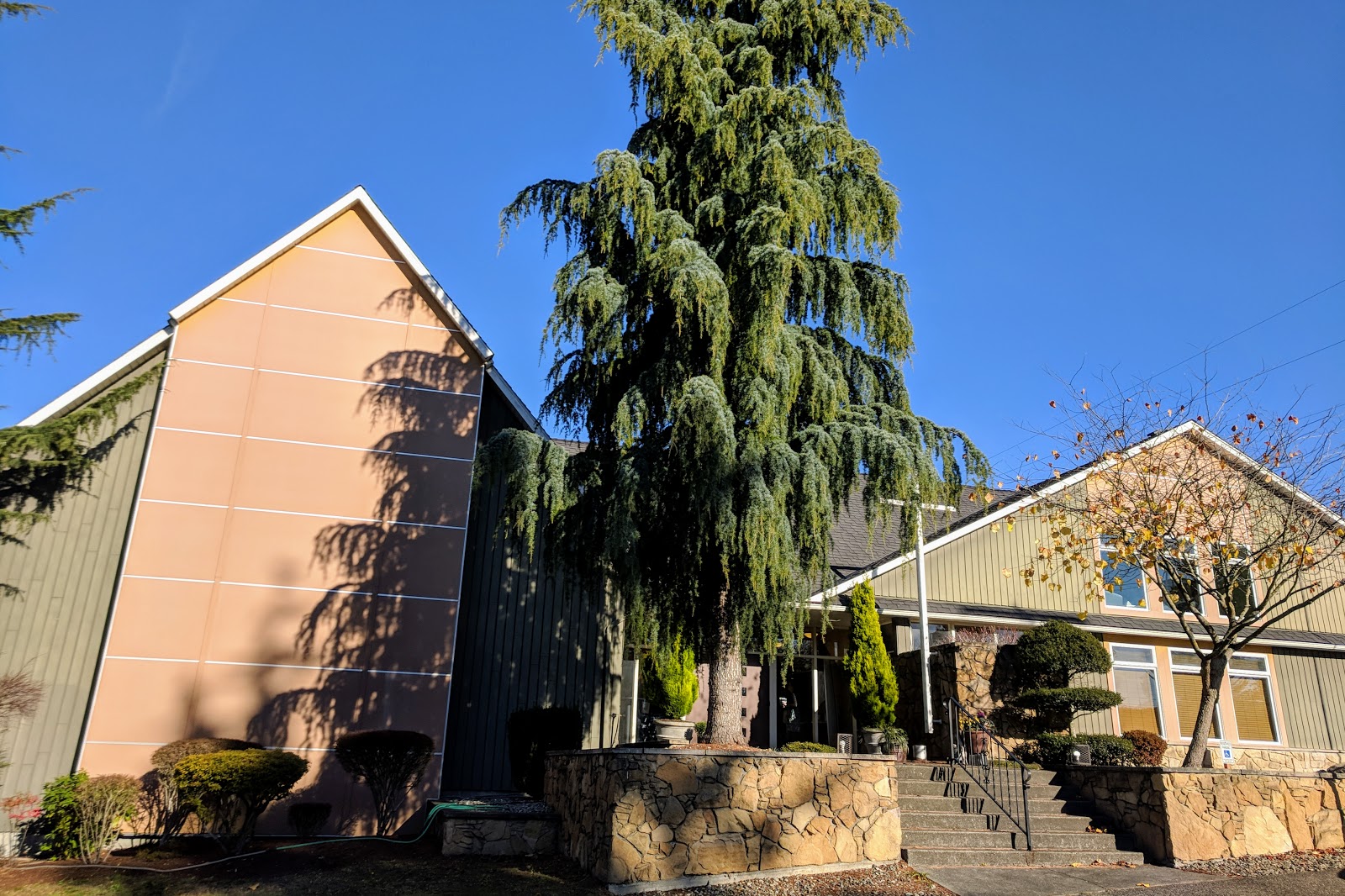
The Hallows Church (West Seattle), Seattle, Washington
A little over five years ago, Mindy and I were visiting our daughter, Paige, who had a summer internship in Seattle. We’d just started visiting churches, (we hadn’t started writing about them yet), and we visited a church here -- Mars Hill. At that time, Mars Hill was a thriving, multi-campus ministry, and we were very impressed. The congregation we visited met in an old church building, and the service was filled with young people. The worship team was wonderful, doing old hymns in new arrangements (loudly), and the speaker happened to be one of my beloved professors from seminary. We all loved our visit that morning.

Not long after that visit, the church fell apart (it wasn’t our fault) There was scandal, not about money or sex, but rather bullying and intimidation. Even though we'd just visited once, we were sad about the whole thing.

I was thinking about this former church because it was mentioned a couple of times in our visit to the West Seattle expression of The Hallows Church; obliquely in the sermon and directly in a conversation after the service.

Mindy had noticed the church soon after our move to West Seattle in July. “The Hallows” is an interesting name, explained by a banner outside featuring the Lord’s Prayer (“Hallowed be Thy name”). We arrived a few minutes before the 10:45 Sunday morning worship service and were greeted warmly by several women just inside the door.

Mindy headed for the coffee in the back of the sanctuary where a man named John introduced himself. We asked when he had begun attending the church, and he told us he came in the summer when his previous church, Living Hope, closed down. We said we’d met other people from Living Hope when we visited All Souls Church, and he said most people from that PCA (Presbyterian Church of America) had gone to either of these two churches.

James, the sole song leader, opened the service, “If you could stand up, we’ll pray, and be off on our merry way.” With his guitar he led a blend of hymns and choruses.

“My name is Andrew, and I serve as one of the pastors here,” Pastor Andrew said as he introduced the announcements. Guests were encouraged to fill out the connection cards and put them in a box in the back of the church (along with tithes and offerings). He also spotlighted areas of need, such as people for the prayer team. He also announced that all three “Expressions” of The Hallows would be meeting on November 28th for congregational prayer. (Besides the congregation in West Seattle, there are also North and Fremont Expressions of The Hallows.) He then dismissed the “little disciples” to Sunday School. He took time to pray for the church (“let us grow into a humble people”).

Before the sermon, there was a quiet time where people could read Scripture and quotes from Christian leaders (such as Martin Luther) projected on the wall at the front. The main text of the morning came from Judges (the church is working through the book), chapter 14:1 through 15:20. This passage is the beginning of the story of Samson.

Andrew said that we might expect Samson to be an admirable character. After all, he was a special gift to barren parents, set apart as a Nazirite from birth (as John the Baptist also was). God promised to use him greatly. And he’s featured in the Bible and all. Andrew pointed out there is a disconnect between those expectations and his actual character. In the stories we looked at, Samson is impulsive, more sensual than spiritual. He is irreverent; eating honey from a lion’s corpse (yeah, weird, read the story) which is a clear violation of the Old Testament dietary laws and his Nazirite vows. He is manipulative and… well… just a jerk.

And yet God, through His grace, used Samson to accomplish His purposes.

Part of the sermon’s point was that giftedness is not a sign of godliness. “In Seattle, we’ve had people that were gifted but not godly, and because of that, people in this area are still hurting.” It’s not much of a stretch to see this as a critique of the leadership of Mars Hill.

After the sermon, Andrew invited us all to the Communion table, “We’ll be worshiping through communion. The table is open. Go at your own pace.” A man at the back of the sanctuary held gluten-free crackers, and a woman held a cup of juice to dip the crackers in.

After the service, we had the chance to chat with a couple of people. Ronda, who’d greeted us at the door, used to attend Mars Hill, and that church had shepherded her through a difficult time. When that church folded, she told us, “I was broken.”

She visited church after church but didn’t find anything like what she had before. She visited The Hallows, and at that time there were only about a dozen people attending. She was frustrated and talked to one of her old pastors at Mars Hill who told her, “You’re going for the wrong reasons. Where can you serve and where you can grow in the grace of Christ?” With that, she knew where she should be.

She went back to The Hallows (which has grown a lot since that time, though the West Seattle expression isn’t a large church). She said, “Andrew is an amazing pastor.” We asked about the strengths of the church, and she talked about it being Bible centered, humble, and involved in the local community.

We also talked to Andrew, who started the groundwork for the church in 2014. They began to meet in 2015. He talked about the church’s focus on Scripture and service, and that Gospel clarity includes telling people the Gospel is not just for the future but for right now. Humility came up again, which obviously is a high value in the teachings of Jesus. “Multiplication is in the DNA of the church,” Andrew added as he described The Hallows’ reasons for existing in (so far) three neighborhood expressions.

He talked about the “missional communities” which might be called “small groups” in other churches. These ministries have three parts: love of God expressed through Bible study, love of church expressed through fellowship, and love for neighbors expressed through service. Each group varies its activities throughout the month to demonstrate these three values.

But we had been occupying Andrew’s time (almost everyone was already out the door, though people had lingered to chat after the worship service ended) so we finally let him go.

Though one of the purposes of this blog is to celebrate the work God does through His church, we must be honest in acknowledging that people are also hurt by the church. The Hallows, among many other good things, is caring for some people who have known that pain. They are doing the good work of hallowing God’s name and bring His Kingdom to earth.

Wednesday, November 14, 2018

We go to church on an island

Orcas Island Community Church, Eastsound, Washington
When Jesus was asked, “Who is my neighbor?” He told the story of the Good Samaritan. Churches need to ask that question in an another way. Perhaps I should churches should ask the question in an additional way. They need to ask it in a practical way. Though a church should care for everyone, even the whole world, a church needs to focus resources on a specific community.

For example, a church located here in Seattle probably shouldn’t send out 700,000 flyers to the whole city when they put on a Vacation Bible School. They need to figure out who their neighbors are, who they can reach with their available resources.

The answers to such questions might be a little easier to figure out in small, isolated towns that are like islands. And, of course, there are literal islands. Like Orcas Island.

Last weekend we went to visit Mindy’s brother Hank and sister-in-law Hilary on Orcas Island. We walked onto the ferry, leaving our van behind, because Hilary had offered us a ride -- and let us use her car on Sunday morning to go to Orcas Island Community Church.

Edie greeted us as we came in the door for the 10:00 am service. It was hard to find a seat. We’ve been to plenty of churches that have open seats minutes before the service, but fill up after the service begins. There were prompt congregants here. We found seats toward the back and side, and we had time to notice that the walls were decorated with patchwork quilts (I assume made by folks in the church). Church bells rang, and the service began.

It was time to worship (and we did sing “Come, Now is the Time to Worship”). Pastor Brian sent children off to Christmas program rehearsal. (Later other kids were sent off to Sunday School, so I guess not all kids are going to be shepherds, sheep, and/or Magi.) People were encouraged to bring in their Operation Christmas Child boxes the next Sunday. There was an announcement for the upcoming Thanksgiving service, with all the island’s churches gathering together at Orcas Island Community Church. The church is hosting a Thanksgiving dinner as well.

There was an announcement for an event that would take place during the service. “Some people will be leaving for a special service somewhere else on the island.” The American Legion Post was holding a Veteran’s Day commemoration at 11:11. Pastor Brian noted that this day was the hundredth anniversary of the end of World War I, and he said we “look forward to the day when all wars will cease.” On the screen there were photographs of that first international armistice.

To honor the veterans, Pastor Brian asked them to stand as their conflict was mentioned. For World War II, two men stood. Then the Korean War, engagements during the Cold War, the Vietnam War, and finally wars in the Persian Gulf and Afghanistan. Photographs of Veterans Day celebrations, beginning with the first as World War I ended, played on the screens at the front, and Pastor Brian said, “We honor those who have followed the call to serve something beyond themselves, in this age of narcissism.”

After a time of quiet reflection and prayer, people were invited to raise a hand and share a prayer request or update. One woman shared, “I have a new grand niece and by the end of the service I’ll have pictures. Not that I’ll be looking at my phone during the service!”

Pastor Brian acknowledged the local cross country team that went to state finals (“Jaydon, one of the fastest runners in the state”) and the soccer team that advanced to semifinals (“Good job, Levi!”)

A woman named Sue said, “I can’t even count the miracles that allowed me to be here today,” leading to cheers and applause from the congregation. Pastor Brian led in prayer, taking time to pray for those threatened by the fires in California and those who have already lost much.

Dick Staub, the church’s preaching pastor, gave the sermon. He preaches every fourth Sunday, and he explained that he was sitting down to speak because “Rabbis sat down to teach. You may think I’m sitting because of neurological problems, it’s because I have something really important to say.”

His message that day was titled, “Deliver Us From the Evil One,” with Matthew 6: 5 - 15 as the text. “This morning we’ll be talking about the Evil One, or as Nigel calls him, Mr. Nasty.” (He mentioned Nigel many times through the service. Nigel is a real person, part of a group of faithful creatives called The Kindlings.) Pastor Staub said he first preached about Satan in a sermon titled “The Devil Made Me Do It” back in 1972 at New England’s first drive-in church. He said the devil always attacks when you preach about him; for instance, Pastor Staub brought the wrong version of the sermon that morning.

During the sermon he talked about the mission of Orcas Island Community Church. “We have a mission statement that everyone on the Island will learn of God’s love through word or deed in a language they’ll understand.”

As I mentioned before, a church on an island is more easily able to define their scope of ministry. And this church looks for a variety of ways to reach out on the community. The day before, after the island’s Hops Fest, a couple of people from the church offered rides home in the church van.

From what we could see, the church seems to be doing a good job of loving their neighbors on Orcas Island. Even visiting neighbors from the mainland -- like us.


Wednesday, October 17, 2018

We go to church way out west

farthest west church in Washington: Neah Bay Presbyterian Church
Neah Bay Presbyterian Church, Neah Bay, Washington
You could say, “Go West, Young Man” applied to us. Except you'd have to change it to “woman and man.” And the “young” part doesn’t really apply.

Otherwise, Horace Greeley could have been talking right to us this past weekend. As we near the end of our “visit a new church every week” project, we thought it would be fun to mirror the beginning of this adventure. Back in 2015, we visited the furthest north, south, east, and west churches we could find in California. Now we’re visiting the furthest north, south, east, and west churches we can find in Washington state.

So this week, we went as far west as we could (easily) go in Washington state, which was also pretty much the furthest west we could drive in the contiguous United States. And we went to the furthest west church we could find.

On Saturday we drove to Klahowya Campground in the Olympic National Forest to spend the night by the Sol Duc River. It was the last weekend the campground was open for the year, and it was very quiet. We got up early the next morning to drive the hour or so to Neah Bay, which is part of the Makah Reservation. We had an hour before church started, so we drove to the parking lot at the base of the Cape Flattery trail, which took us as far west as we could go. Then we drove back to Neah Bay.

Mindy’s research had found two possible churches: an Assembly of God Church and a Presbyterian Church, both in Neah Bay. We were leaning Presbyterian because we were pretty sure of when the worship service was. When we saw the two churches, which are a block apart, we did some eyeball calculations. It looked like the Presbyterian Church seemed to be a few feet more to the west.

We arrived at 10:30 am and looked at the sign on the side of the church that read Sunday School at 9:30. Some children filed out of the church and got into cars to go home. (We heard later that 12 - 15 kids have been attending Sunday School class, some from families that don’t attend the church.) The sign said the worship service started at 10:45, but when we got inside, Pastor George greeted us and said the service actually started more 11-ish.

Pastor George, sitting at a long table with his laptop, offered coffee and the restroom (after camping with minimal fire and water, Mindy appreciated the hot coffee and I appreciated the flushing). We sat at the table with Pastor George, and as other people came in the room, introduced us all as they sat at the table for a chat.

Some of the women who joined us told us about the history of the church, which for decades was, apart from the Indian Shaker church (unrelated to the Shakers we’d heard of before), the only church in town. They told us that the mural at the front of the sanctuary was financed by women in the church selling cookbooks. We heard about the church’s choir in the 1950’s and ‘60’s (we were urged to visit the local museum, where reel to reel tapes of those choir performances were housed).

One of the grandmothers quoted her granddaughter saying that they need to “pay attention to Pastor George and God” during the worship service. There was speculation that some might not make it to church that morning since the Seahawks were playing the Raiders in London, and the game had already started.

Pastor George mentioned he was disappointed that he hadn’t received more information from the denomination on disaster relief for the recent Florida hurricane. Since that hadn’t come in, he wondered if Mindy and I would be willing to share for their Minute for Missions. (Of course we agreed). By then, it was 11ish, so Pastor George asked the group if we should just go on chatting around the table or should we go to worship? Unanimous agreement on worship.

We sang many of our favorite hymns that morning, with music provided by the playlist on Pastor George’s tablet (“Take My Life,” “A Mighty Fortress is our God,” “Immortal, Invisible” among them). During the Passing of the Peace, there was time for everyone to shake the hand of every other person, and they did. During the Minute for Missions, Mindy and I told how we’ve seen God work in powerful ways through His Church, particularly Vieux Carre Baptist Church in the French Quarter of New Orleans.

Pastor George prayed for us, which we greatly appreciated. People shared other needs for the prayer time, which concluded with the Lord’s Prayer. (There was a moment of “Debt” / ”Trespass” confusion. We’ve experienced it other churches, too. Pastor George blamed his Methodist upbringing.) Pastor George prayed for hurricane victims in Florida, the local schools (including the high school football team), the tribal council and state government, and the upcoming elections.

The congregation is following the lectionary in their worship services, with Scripture readings from the Old Testament, New Testament, Psalms, and Gospels. The Gospel reading (for which we stood) was the story of the rich, young ruler from Mark. Pastor George commented, “That one caught my eye and kicked me in the backside.” He went on to say, “We’ve all had opportunities to give to the poor; sometimes we take them, and sometimes we don’t.”

After church, we had more time to chat around the table, this time with snacks along with the coffee. We couldn’t stay long, though; we had a long drive back to Seattle. Several people wished us well and even mentioned they’d be praying for us.

The Old Testament Scripture from the lectionary that morning was from chapter 23 of the book of Job. Verses 8 & 9 caught my attention, “But if I go to the east, he is not there; if I go to the west, I do not find him. When he is at work in the north, I do not see him; when he turns to the south, I catch no glimpse of him.”

I hate to disagree with Job, but we saw God at work in His Church in the east of Washington, and this week we saw it in the west. We trust we’ll see the same in the north and south over the next couple of weeks.