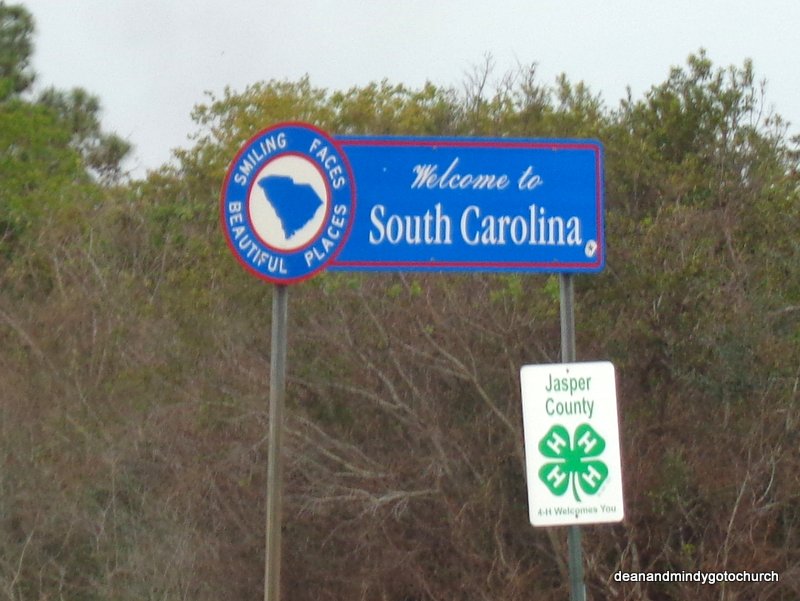
Don't tell anybody, but instead of staying completely in one state this week, we've been on the border between North and South Carolina, going back and forth multiple times a day. We'll
officially cross into North Carolina this afternoon, so for now, let's pretend we've been in South Carolina every minute of the past week.
1. The state foods are peach,
collard greens, and
boiled peanuts.*
2.
Lake Wylie, a 13,400 acre man-made reservoir, is the state's 8th largest lake**
3. The
first European settlement (it was led by a Spaniard, Lucas Vazquez de Ayllon) on the North American continent may have been in what's now South Carolina, founded in the fall of 1526.*** The community was abandoned after about three months due to illness and harsh winter weather. However, the settlement lasted long enough to hold the first Catholic mass on North American soil; two
Dominican friars were among the settlers.
4. When the English colonized what's now South Carolina, the
Low Country in the southern part of the state had very fertile soil and good harbors. Religious tolerance was another factor in the prosperity of the area. The colony was named in honor of
King Charles I of Great Britain****
5. In 1776, South Carolina became a republic and elected a president. In 1778, South Carolina was the first to sign the
Articles of Confederation, making it a part of what would become the United States. At the time, slaves were vital to the economy (and had made up half the population since at least 1708), which was dependent upon
indigo and rice farming. The state was also the first to vote to secede from the Union in 1860.
6. The
American Revolution was an opportunity for slaves to obtain freedom by running away to the British. An estimated 30% of slaves in South Carolina (about 25,000 people) fled, migrated, or died during those years. As a result of the
Great Migration, in which many black Americans headed north in search of jobs and opportunities denied them in the South, the state had a white majority in 1930 for the first time since 1708.
*we did not eat any of these foods while in South Carolina. Oops.
**the border with North Carolina pretty much bisects the lake. I didn't look up how much of the total acreage is actually in South Carolina.
***then again, it might have been in Georgia, or near the Chesapeake Bay. Scholars differ, and the settlement's founder didn't leave clear notes. He died there, though, as did about half of the 600 settlers.
****
Carolus is Latin for Charles. And if you know your English history, you realize that this is the king who was beheaded during the
English Civil War.