Showing posts with label american revolution. Show all posts

Wednesday, August 3, 2016

Massachusetts churches -- not just in Boston

Trinity Episcopal Church, Boston, MA
Trinity Church, Boston
Massachusetts, not surprisingly for a place that was founded by people who thought a lot about matters of religion and faith, has a lot of churches. Some of these churches have amazing history going back to colonial times; others began in the nineteenth or twentieth centuries. We found them interesting.

Park Street Church, Boston


Park Street Church as seen from the Commons

St Mary - St Catherine of Siena, Boston

St Stephen's Roman Catholic Church, Boston
St Stephen, Boston


We did go to Plymouth, though we didn't happen by any churches.

These churches in the neighborhood of Central Park in Clinton were particularly impressive. First Baptist and First Congregational seem to have more than one congregation meeting in each of their buildings.
First Baptist Church, Clinton, MA
First Baptist Church, Clinton
First Congregational Church, Clinton, MA
First Congregational Church, Clinton
Seventh Day Adventist Church, Clinton, MA
Spanish-language Seventh Day Adventist Church in Clinton


And one final church from Boston, for several reasons. Old North Church has history (remember Paul Revere and one if by land, two if by sea?), it's beautiful from the outside, and it's beautiful from the inside. Plus it was a welcome cool spot on a very warm summer day.
Old North Church, Boston
Old North Church steeple from the park


Can you see the lanterns in the steeple?

What did we miss?


Monday, August 1, 2016

6 old facts about Massachusetts

statue of George Washington, Boston, Massachusetts
1. Boston is the capital and the largest city of Massachusetts. Over 80% of the state's population live in the Boston metropolitan area.

Plymouth Rock, Massachusetts
2. Plymouth was the site of the first colony in New England. Founded in 1620, it was the second permanent English colony in what was to become the United States. The Puritans, who founded the colony, believed the Church of England to be in need of purification. The colony was organized around their beliefs, which led to intolerance (and banishment) of dissenters (whose religious beliefs and practices differed from Puritan beliefs and practices).

Minuteman statue, Concord, MA
3. American colonial protests against Great Britain grew after the end of the French and Indian War (1763), especially with regard to taxation. (Remember hearing about the Boston Tea Party? yup, taxation issues)

4. The Battles of Lexington and Concord (in Massachusetts) were the start of the American Revolutionary War. After these battles, George Washington became the leader of what was soon the Continental Army.

5. During the Civil War, Massachusetts was the first state to recruit, train, and arm a regiment of black men (with white officeers), the 54th Massachusetts Volunteer Infantry.

6. As of February, 2016, 53% of the registered voters in the state were not enrolled in any political party.

Wednesday, May 25, 2016

We walk into a church in Annapolis (and drive past several more)

Usually on Wednesdays, we post several photos of the outsides of churches from the state we most recently visited. Today is different.

The very first church we noticed was in the heart of Annapolis, just a few blocks from the state capitol. St. Anne's was the church home of three signers of the Declaration of Independence and of Francis Scott Key, who wrote the lyrics to the National Anthem. And the door was open, and it's beautiful.

So even though we've put pictures from a few other churches at the end of this post, we thought you'd most like to see the the church on the circle in Annapolis, St Anne's Episcopal.


And the other churches, as seen from the outside.
Church of Life in Jesus, Highland, Maryland
Church of Life in Jesus, Highland

Epworth Methodist Church, Gaithersburg, MD
Epworth Methodist Church, Gaithersburg

Gaithersburg Presbyterian Church, MD
Gaithersburg Presbyterian Church

Good Hope Presbyterian Church, Fulton, Maryland
Good Hope Presbyterian, Fulton

Trinity Episcopal Church, Elkridge, Maryland
Trinity Episcopal Church, Elkridge

Resurrection Baptist Church, Silver Spring Maryland
Resurrection Baptist Church, Silver Spring

Saint Patrick Catholic Church, Rockville, Maryland
St Patrick Catholic Church, Rockville

Saint Paul's Lutheran, near Annapolis
St Paul's Lutheran, near Annapolis

Monday, April 4, 2016

6 (somewhat) surprising facts about South Carolina


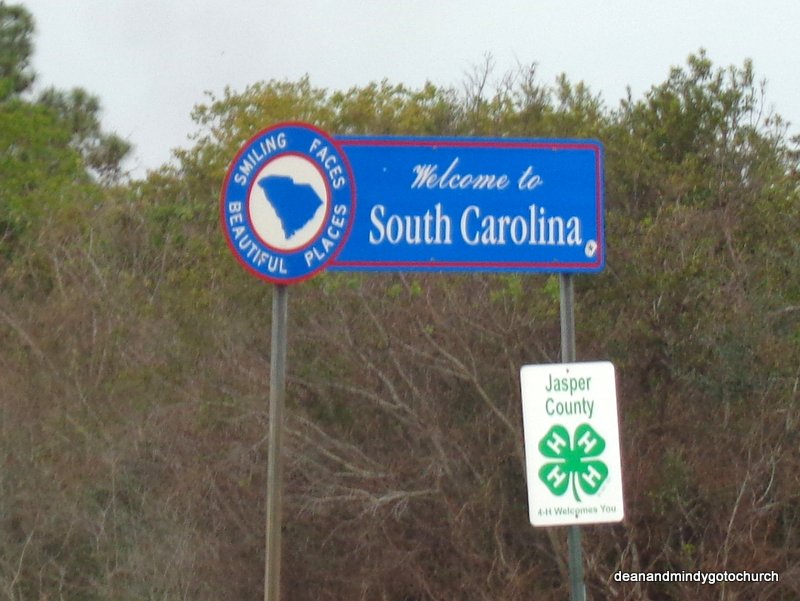
 Don't tell anybody, but instead of staying completely in one state this week, we've been on the border between North and South Carolina, going back and forth multiple times a day. We'll officially cross into North Carolina this afternoon, so for now, let's pretend we've been in South Carolina every minute of the past week.

1. The state foods are peach, collard greens, and boiled peanuts.*

2. Lake Wylie, a 13,400 acre man-made reservoir, is the state's 8th largest lake**

3. The first European settlement (it was led by a Spaniard, Lucas Vazquez de Ayllon) on the North American continent may have been in what's now South Carolina, founded in the fall of 1526.*** The community was abandoned after about three months due to illness and harsh winter weather. However, the settlement lasted long enough to hold the first Catholic mass on North American soil; two Dominican friars were among the settlers.

4. When the English colonized what's now South Carolina, the Low Country in the southern part of the state had very fertile soil and good harbors. Religious tolerance was another factor in the prosperity of the area. The colony was named in honor of King Charles I of Great Britain****

5. In 1776, South Carolina became a republic and elected a president. In 1778, South Carolina was the first to sign the Articles of Confederation, making it a part of what would become the United States. At the time, slaves were vital to the economy (and had made up half the population since at least 1708), which was dependent upon indigo and rice farming. The state was also the first to vote to secede from the Union in 1860.

6. The American Revolution was an opportunity for slaves to obtain freedom by running away to the British. An estimated 30% of slaves in South Carolina (about 25,000 people) fled, migrated, or died during those years. As a result of the Great Migration, in which many black Americans headed north in search of jobs and opportunities denied them in the South, the state had a white majority in 1930 for the first time since 1708.

*we did not eat any of these foods while in South Carolina. Oops.

**the border with North Carolina pretty much bisects the lake. I didn't look up how much of the total acreage is actually in South Carolina.

***then again, it might have been in Georgia, or near the Chesapeake Bay. Scholars differ, and the settlement's founder didn't leave clear notes. He died there, though, as did about half of the 600 settlers.

****Carolus is Latin for Charles. And if you know your English history, you realize that this is the king who was beheaded during the English Civil War.