Showing posts sorted by date for query wedding. Sort by relevance Show all posts

Thursday, May 17, 2018

Mindy goes to a movie

Movie Night, Greenwood Village South, Greenwood, Indiana
Dean was at home in Fresno this past week, and his work schedule restricted the time he had for visiting a new church. I, on the other hand, was visiting my dad in Indiana to celebrate his 90th birthday. While there were plenty of "church" activities available, we'd already written about a wedding and about worshiping at Southport Presbyterian Church. Due to other obligations, I wouldn't be able to visit the morning devotional times, Bible studies, or hymn sing held at various times through the week at Greenwood Village South, the retirement community where my dad lives.

What to do?

Thankfully, two showings of The Hiding Place were scheduled for the weekend. It's the only film made by the Billy Graham Association in which Billy Graham doesn’t appear, and while Dean had hoped to include it in April's Christian Movie Month over at Movie Churches, there just weren't enough weeks.

The film (based on the book of the same title) is the true story of one family’s response to the Nazi persecution of Jews in the Netherlands during World War 2. Corrie ten Boom and her sister Betsie lived with their elderly father, a watchmaker, and their lives had revolved around family and service to the community, with Christian faith motivating their everyday activities. As persecution of Jews became more and more brutal, the sisters realized that they had to find a way to care for those their father called “the apple of God’s eye.”

When a man they'd offered to help betrayed them, Betsie, Corrie, and their 85-year-old father were arrested. Casper ten Boom died ten days after their arrest; the sisters were held and eventually transferred to Ravensbruck concentration camp. Corrie struggled to forgive the brutal guards and to trust God's love, even as she recognized His care for them in such things as providing medicine and allowing them to have a Bible.

I wondered what it would be like to watch the movie with people who had some memories or even first-hand experiences from that time. I also wondered how the audience -- generally church-goers, but not exclusively -- would respond to the very evangelical message of the film.

It turns out, the audience was pretty much like any other movie audience: they joked about hurrying from dinner to the movie (one man had brought his dessert along). They teased the employee who brought popcorn and got the movie started. One woman in the row ahead of me wondered aloud where else she’d seen one of the actresses. One couple left after the scene in which the ten Booms were arrested, and I wondered if it was because of the scene’s violence.

I was surprised that the 40-year-old film had as much impact as it did when I first saw it, years before Schindler’s List. A few quotes will give you an idea:

When their nephew says, “Whatever helps Holland is right” while asking Betsie and Corrie to pass information vital to sabotage a German project (by bombing it), Corrie refuses, wondering, “What will we be like when this is over?”

Later, a Jewish professor hiding in their home asks her, “You have your father and your religion. Has it been enough?”

Corrie smiles, “More than enough. God has been very good to me.”

A pastor refuses to help the ten Boom family hide a Jewish baby. “Where would the church be without their pastor?” he asks, noting that he could be arrested and that the Bible instructs people to obey the law.

Corrie’s father, who has embarrassed the pastor by wearing a yellow star as a symbol of his support of the Jews (who are required to identify themselves), tells him, “We are meant to obey the law of the land unless it goes against the higher law. I will take off the star, but we will keep the child.” That baby is the first of many, many Jews whom the family hides, providing ration cards, false identities, and room in their home -- including the secret room behind Corrie’s closet.

In other words, the film held up. Issues of concern for the suffering, persistence in difficulty, forgiveness when wronged, and trust in God's care resonated with me. In spite of the movie's two-and-a-half-hour running time, few people got up for more popcorn, whispered, or even went to the bathroom.

As the credits rolled, the two dozen people in the meeting room left much more quietly than they had entered. I wondered if the lateness of the hour (it was after 9:00 pm) or the emotion of the story was the reason; I wondered if anybody in the group talked about the movie the next day.

I wondered how far I’m willing to go in God’s service and how much I'm willing to trust Him.

Tuesday, April 3, 2018

We go to church alone on a Friday

Good Friday at Fresno First Church of the Nazarene, Fresno, California
Fresno First Church of the Nazarene, Fresno, California
The mariachi music coming from the wedding at the house across the street was quite loud, but otherwise, the neighborhood surrounding Fresno First Church of the Nazarene seemed quiet. As we walked into the church lobby, we could hear the music from the outside and also worship music from inside the sanctuary.

The lobby was empty except for the chairs in the comfortable seating area beneath a lovely stained glass window. We looked at the display wall covered with remembrances of the church’s history (including a plaque from May 5, 1985, commemorating the church’s 75th anniversary). We peeked in the sanctuary; no one was inside, but we did see stations set up for a meditative journey.

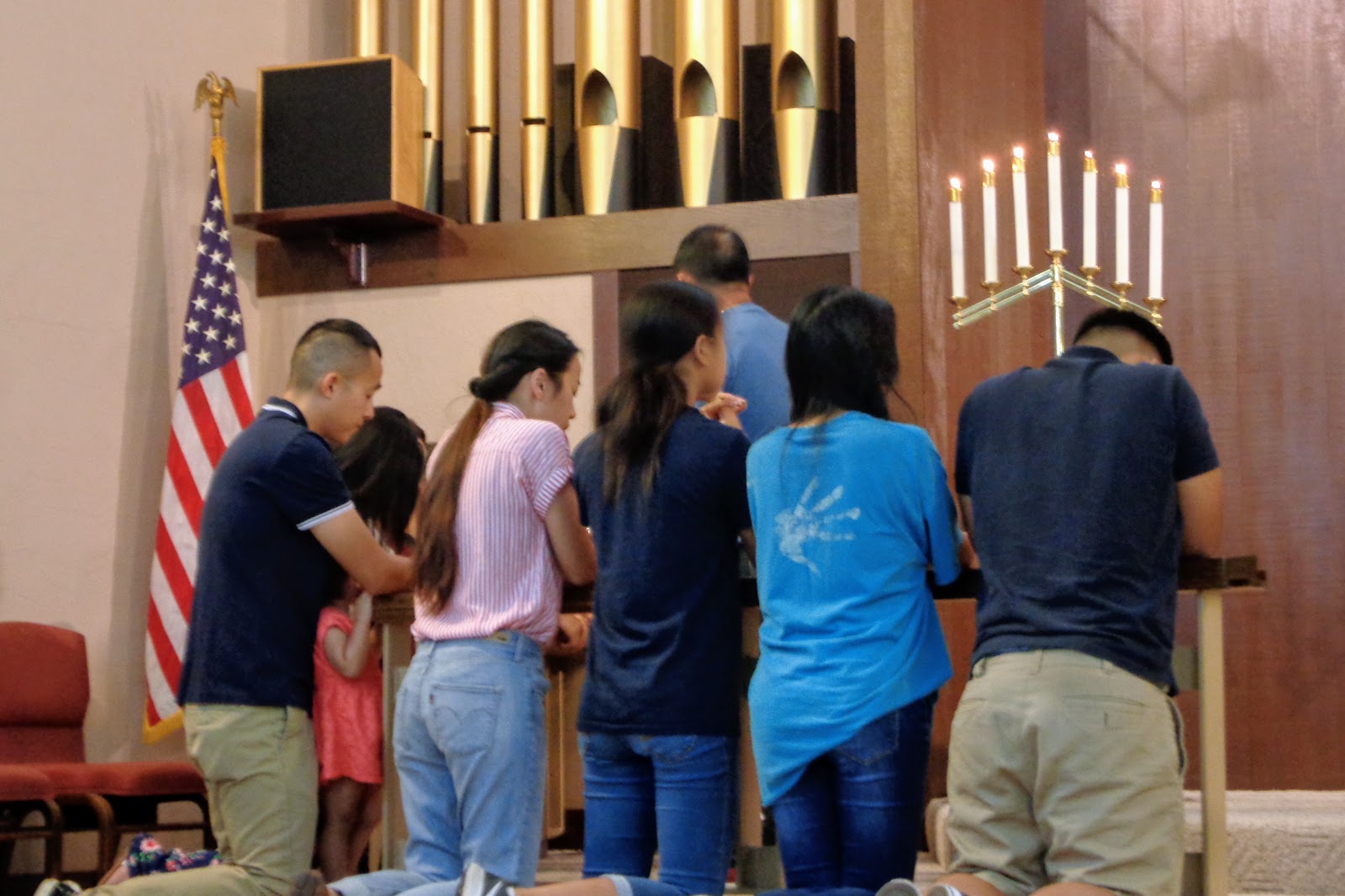
To our right as we entered the back of the sanctuary, we saw a table covered with votive candles and a sign marking it as the first table, “Preparation.” The Mary and Martha passage from Luke 10 was written on a piece of paper, with encouragement to take time, like Mary did, to slow down and reflect on Jesus, then to light one of the candles. Protestants don’t get nearly as many opportunities to play with fire as Catholics.

Taped arrows on the carpet directed us to the next station, “Reflection,” which contained Scripture about Jesus’ entrance into Jerusalem on Palm Sunday. (The remainder of the stations focused on different days of Holy Week). The “Reflection” station encouraged us to make Jesus King in our lives.

At the next station, “Communion,” we jumped several days ahead in the week, to Maundy (or Covenant Thursday). The table contained pita bread and a cup of grape juice with instructions encouraging us to remember Christ’s sacrifice as we dipped the bread in the cup and ate. The bread was soft and fresh, and the juice was sweet.

A few feet beyond the communion table was a cross, the fourth station, representing that very day, Good Friday. The paper on the lectern next to the cross had the most widely quoted verse from the Bible, John 3:16, along with the following verse as well (“For God did not send His Son into the world to condemn the world, but to save the world through Him”). The paper noted that people in the world are pretty good at condemning others, but that isn’t why Jesus came. The paper encouraged people to write an ongoing struggle or sin on one of the index cards next to the paper, then lay it at the foot of the cross.

While I was standing by the cross at the front of the church, I noticed a woman enter the room with two children. I thought how wonderful for a family to be able to walk the path, going as fast or slow as needed. The children spoke quietly with the woman as they read at each station, then sat and (I assume) prayed silently before moving from one station to the next.

The fifth station was labeled “Quiet” and marked the Saturday of Holy Week when Jesus was left in the tomb. That station’s instructions noted that Jesus died to make a way between God and people, and encouraged people to write the names of those who needed to know Jesus on the paper table covering and to light a candle for them as well.)

The final station was Easter, “He Is Risen.” It was jumping the gun a bit on that Good Friday, but I felt satisfied, knowing that the story ends so well. While I was standing at that station, “Come Thou Fount of Every Blessing” began to play; and I needed to stay for the whole song. It is perhaps my favorite.

When we exited the sanctuary and returned to the lobby, Chris Archer, the church’s pastor, greeted us. We told him how much we appreciated the chance to meditate on work of Christ in this creative fashion. The sanctuary was open from 3:00 pm until 8:00 (we were there between 5:30 & 6:00). Chris said some of the older folks from the church had come when the sanctuary opened; he expected more people to come after work or dinner.

Chris told us he’d been at the church for three years and invited us to return on Easter. Knowing churches, we knew there would be many more people on Sunday, but we appreciated the opportunity to go to church when we could be alone. Because we weren't alone at all.


Wednesday, November 15, 2017

We Go to Church and Talk to Strangers about Fires

The Bridge Church, Santa Rosa, California
We’d already decided to spend last weekend in Santa Rosa when Mindy started looking for places where we could volunteer while we were there. It’s a good thing that she had a hard time finding a place that would let us help -- there are many organizations working on many projects, but most had more than enough volunteers for the Saturday we were available.


Eventually she remembered that Samaritan’s Purse, the international relief organization, was working through The Bridge Church in Santa Rosa (not connected with The Bridge Fresno), and she applied for Saturday morning training and work with other one-day volunteers. Due to a breakdown in marital communications (I’m sure it only happens to us), I had given up on volunteering and arranged for us to meet friends for lunch.


Nevertheless, Mindy went to the training early Saturday morning, if only to apologize that she couldn’t go out with the groups. She got permission sit in on the orientation that prepared volunteers for the work they’d be doing that day.


The group watched a video that prepared them to work at sites where homes had so recently been. They were reminded to wear protective gear, which would be provided on-site. They were trained to avoid nails and to be considerate of the homeowners, who would also be on the property. Then they were assigned to groups to go to the various area sites. Mindy had noticed a few people with The Bridge Church t-shirts, and when she asked if they were part of the church, she found herself talking with Eli Contreras, the church’s worship and young adults pastor. A few minutes later, that group was excited to find out they’d be working at the home of friends from The Bridge Church.


After the volunteers left to go to their work sites, Mindy came back to fetch me. We drove into the hills of the Fountaingrove area on the northeast side of Santa Rosa, where we were introduced to one of the property’s owners who was looking at what had been saved and what had been lost to the fire.

The house was gone except for a few stone walls, but the tree house in an oak tree was fine. Their beehives had survived the fire, but the smoke might have weakened the bees that were left, allowing yellowjackets to invade and take over the hives. She graciously allowed us to take pictures of the work on her property (Samaritan’s Purse requires volunteers to get permission for photos, and common courtesy does too).


Mindy introduced me to Eli, who was unrecognizable in Tyvek coverall and breathing mask. As we watched, Keith, the site supervisor from Samaritan’s Purse, advised people to keep away from the area around a damaged wall. That area would be cordoned off to prevent accidental injury.

People were hauling metal conduit to a pile for recycling, and everyone seemed to be in good (but not jovial) spirits. Though we were in a beautiful hilltop on a beautiful day, a sense of loss hung over the morning. Later, when some of the debris had been hauled away, the group expected to help the owners sift through the ruins of the house for belongings that might have survived the firestorm. They also hoped to catch sight of the family's cat, who'd been missing since the night of the fire.


That night, when we went to the Saturday evening worship service at The Bridge Church, we couldn’t help noticing the big Samaritan’s Purse trailer parked in the lot. We heard that the trailers had been built for NASCAR and were equipped with tools and shop materials as well as supplies for use on disaster sites.


The Bridge Church meets at the Santa Rosa Alliance Church on Fulton Road (near, but outside one of the fire evacuation areas). The Bridge was a two-location church, with one congregation meeting in the Larkfield neighborhood of northeast Santa Rosa at a Seventh Day Adventist School. The congregation had kept the equipment they set up every week in a trailer stored in the school’s parking lot, and the school was destroyed in the fire. The church assumed all their equipment was lost along with the meeting site, but when, after the fires, they were allowed back onsite, they found their trailer in perfect condition by a wall on the edge of the parking lot (we saw the trailer in the Alliance Church parking lot that evening).


The Saturday evening service began promptly at 5:00 pm with music followed by a greeting time (with a timer), more singing, then the sermon. Pastor Billy Andre was beginning a series, “Different,” on the Apostle Peter’s first letter.


In his introduction, Billy mentioned that the letter was written to a church that was enduring great persecution under the Emperor Nero (famed for fiddling while Rome burned), and the Bible verses that especially struck me were from I Peter 1 -- the quite relevant verses 6 & 7: “In this you greatly rejoice, even though now for a little while, if necessary, you have been distressed by various trials, so that the proof of your faith, being more precious than gold which is perishable, even though tested by fire, may be found to result in praise and glory and honor at the revelation of Jesus Christ.”


Billy said people of Sonoma County are suffering immensely, but not only from the fires. As is true in any time, in any place, people have struggles with health, relationships, and finances. These trials, he said, are a test of our faith, but our God is a God who can redeem painful situations.


The message was perhaps more powerful because Pastor Andre, like many in his congregation, is going through a trial of his own. His family’s home was destroyed in the firestorm, and they’re staying in their fourth residence in a month. He told about going to where his home used to be to sift through the ashes. He and his wife hoped, more than anything else, to find their original wedding rings, which had been in a dish on their dresser.


They did find them. They also found something that surprised them: a picture of Jesus. It wasn’t from a book they’d owned, and they had no idea where it came from, but there it was in the ashes where their shed had been: a reminder that God was with them.


The service closed with the song  “I Have This Hope” by Tenth Avenue North, which includes the lyrics, “I have this hope in the depth of my soul: in the flood or the fire, You’re with me and You won’t let go.”

Many of my friends lost their homes in the fires, including Mike, who I've known since elementary school. I remember biking to his house to hunt with BB guns...I accidentally shot him once. This week, his wife Carol posted on Facebook, "From this day, we move forward. Samaritan's Purse showed up today with a team of twenty people to help us sift. Beauty from ashes. God has a good plan for our family."

I trust also that God has a good plan for the people of Sonoma County, and I'm grateful that Samaritan's Purse -- and the churches in the community -- are working with them to help find it out.

Wednesday, October 4, 2017

We go to Mass in Las Vegas

Guardian Angel Cathedral, Las Vegas, Nevada
There are a lot of ways Las Vegas is different from other big cities in the United States -- not just because of what it has (the casinos and strip clubs), but also because of what it doesn’t have. When you drive down the major streets of most cities, you see churches. Sometimes they're old or even dead churches, but they’re there.


When you drive down the best known street in Las Vegas, the portion of South Las Vegas Boulevard known as “The Strip,” you don’t see churches. Sure, there are wedding chapels -- but anyone who works in one will make it quite clear those chapels are not churches. Many people who visit Las Vegas see only their hotel, some casinos, restaurants, and night clubs. When we visited Las Vegas this time, though, we found a church in the shadow of casinos.


Guardian Angel Cathedral, a Roman Catholic Church, is just off South Las Vegas Blvd. You walk out the front door and look straight out at Trump Tower. Like other buildings in the neighborhood, the architecture of Guardian Angel isn’t subtle. The A frame is large, but the cross-topped tower is even taller, with a statue of the Holy Family beneath it. Inside the cathedral, the stained glass windows are elaborate and quite beautiful.


Catholics definitely have an advantage over Protestants when they go to church in a new place. They can go anywhere in the world, and most of the worship service will be what they’re used to. The rituals of the liturgical year will be the same. For those of us who aren’t Catholics, we’re confused. We have to watch other people to know when to sit, when to kneel, when to stand, and what page to turn to in that little paperback book on the back of the pew. By now, Mindy and I have visited enough Catholic churches to get some of it right, but I always wonder what it’s like for visitors with no prior church experience.  


Even among Catholic churches, though, there are differences. A couple hundred people showed up for the 8:00 am Mass at Guardian Angel (You see lots of people on the streets in the afternoon, evening and even 2:00 am Sunday morning, but not so much at breakfast time. Apart from worship services, it’s a rather quiet time around town). This service had a fair deal of singing and the woman leading the singing (the cantor) had a very nice voice.


A part of worship in the Roman Catholic church that can throw some Protestants off is the two offering thing. The first offering goes to who knows what, but then the priest or a deacon up front says, “This morning’s second offering goes to …” some very cool ministry, perhaps to homeless in the neighborhood or hurricane victims or starving people in Africa. As an unprepared visitor, you already put the money you brought into the first offering. It’s frustrating.


The Gospel reading at Guardian Angel that morning (as at Catholic churches throughout the world) was from Matthew 21: 28 - 32, the story of the two brothers. In the story, the father asks the sons to do some work. One says he won’t, but then goes and does the work. The other brother says he will do the work, but then he doesn’t. The priest pointed out that God cares more about what we do than what we say.


Another strange thing is noticing who doesn’t go forward for communion. I don’t go, because I know that in the Catholic Church, the Eucharist is for Catholics who are in good standing. So I stay seated. But I observed people near me who knew when to sit and when to stand and when to kneel and to kick up the kneelers (which makes quite the simultaneous clunking sound), remain in their place rather than going forward. I know why I shouldn’t go, but I always wonder why that person doesn’t go forward.


There are moments during Mass when I feel like an outsider, but when Scripture is read, songs are sung, and even when people are shaking hands around me, I feel like I’m in the catholic Church, Christ’s Church encompassing all who believe in Him.


I hope that particularly this week, when so many in Las Vegas are suffering, grieving, questioning, and seeking, they can find hope in this church.


Statistics
Service Length: 52 minutes
Sermon Length: 7 minutes
Visitor Treatment: Near the end of the service, the priest welcomed visitors and invited them to return next time they were in Las Vegas
Followup by Tuesday Morning: none
Our Rough Count: 220
Snacks: none
Musicians: organ (woman)
Vocals (cantor, woman)
Songs: “Crown Him with Many Crowns”
“Glory to God in the Highest”
“Remember Your Mercies, O Lord”
“Lord, This Time, Change our Hearts”
“Here I am, Lord”
“Holy, Holy, Holy, Lord God, Almighty”
“Save us, Save us, Savior of the World”
“Amen, Amen, Amen”
“Lamb of God”
“Teach us, O God, to Follow Your Ways”
“Amazing Grace”
“They’ll Know we are Christians by our Love”
Distance to Church: 3 miles
Open WiFi: no
Tie/Suit Count: at least 3 (all the ushers wore suits)
Church Website: gaclv.org

Wednesday, June 28, 2017

We go to the Hmong Church we Noticed First

Peace Lutheran Hmong Ministry, Fresno, California
"Why do you worship the American God?”

Kaying Lee, whose husband is pastor of the Hmong ministry at Peace Lutheran Church, told us she sometimes hears this question from people in the Hmong community. She explained to us that Christianity is new to Hmong people, and many see it as a Western religion -- until they get to know it better.

The Lees have served at Peace Lutheran in Fresno since 2008. Many of the younger Hmong of the church attend the morning English language service, but some are more comfortable attending the Hmong language service at noon.

Kaying herself grew up in far from the United States and the Christian faith. Hmong have traditionally lived in the mountain and hill country of Southeast Asia where, Kaying told us, in many ways the  culture was like that of the Old Testament. As an example, she pointed to the constraints against a younger daughter marrying before her older sister which were common to her culture and the stories of Genesis.

As a child, Kaying lived in a refugee camp for a time, and she came to the United States when she was 15.  She met her husband Khai in the United States, though their families had known each other for generations.But she believes the Hmong community needs the love, peace, and forgiveness found in the Gospel of Jesus Christ, so their church looks for ways to reach that community. Every year the church participates in one of the large New Year’s celebrations held in Fresno. This year they gave away CDs of Hmong language Christian music.

Kaying greeted us in the parking lot of the church as we arrived at the Sunday School hour. She gave us several suggestions of classes to attend, but I happily accepted the chance to sit in on the high school class.

Janett Lee, Pastor Khai and Kaying’s daughter, led the class (we didn’t know they were related until after class). Janett started working with the Hmong youth when her parents started at the church, but a few years ago the English language congregation of Peace was without a youth pastor, so they combined the two youth groups, with Janett becoming the official youth leader in 2013.

The classroom was a bit messy that morning, since there had been a wedding the day before and the Sunday School room was the changing room for the bridal party. During the week, the room had been used for the church’s Vacation Bible School.

The high school lesson was on Easter morning’s empty tomb, looking at the various Gospel tellings of the Resurrection story. Students continued to come in throughout the hour until there were eighteen kids in the room. Janett used Scripture for the lesson but also used Luther’s Small Catechism with Explanation. (Kaying mentioned that one of the good things the Lutheran Church offered the Hmong people was the Catechism with its clear presentation of Scripture and theology.)

We weren’t the only bonus adults in class that morning. David, an elder in the church, sat in to observe for a bit. I tried not to talk too much, but the youth pastor in me couldn’t refrain from adding a comment or two.

I talked with Janett after class about her work with the youth. She said that at times they’ve had some troubled kids. She described a kid from several years back who was a bit of a gangbanger, until he decided he prefered what the church had to offer. Their ministry emphasizes service, looking for ways to reach out to the community. If they do a beach trip, they’ll spend an hour picking up litter.

While I talked to Janett, a number of the kids were putting on choir robes. We learned that the youth provide the music for the Hmong worship service.

We went to the sanctuary for the worship service, and Kaying invited us to sit with her in the front row so she could explain what was happening in the service. Much of the music was familiar (“Amazing Grace,” “Jesus Saves”), but the words were Hmong. The youth choir also sang some songs in English during the service.

The Scripture readings were in Hmong, but the Hmong spelling of the names of Biblical books are close enough figure out. (Besides, Kaying told us as well.) It’s interesting to hear the Lord’s Prayer and the Apostle’s Creed in a different language, because the cadences and rhythms are familiar even when the words aren’t.

Janett gave a children’s message in English, the youth sitting with the little kids --  who were brought in from their class for the story -- in the front.

Pastor Khai’s sermon on Psalm 91 was in Hmong, but on occasion there were phrases and whole sentences in English. I asked him after the service whether he did that for our benefit, and he assured us he hadn’t. He said that some things are just easier to say in English than in Hmong, which makes sense.  Hmong Christians haven't had many years to come up with words for Biblical, spiritual, and theological concepts that the church has been trying to put in words for millennia.

Kaying went forward with us for communion, which I appreciated because even though a Lutheran communion is pretty much a Lutheran communion (open hands to receive communion, closed hands for a blessing), I was concerned I’d miss an instruction in Hmong and do something embarrassing (maybe not like pouring the wine down my front, but who knows?).

In the closing announcements I heard the words “silent auction” and “egg rolls;” then Janett announced that the church had a fireworks booth in the SaveMart parking lot  to raise money for youth projects. (I’m pretty sure the fireworks announcement was in English, unless I really caught on to Hmong this month.) I know where we’ll be getting our sparklers.

Everyone was quite gracious and welcoming; Kaying let us know we’d be welcome at any time and invited us to a wedding later this summer. It was good to worship the Hmong God with folks at Peace Lutheran. (Who happens to be one and the same with the American God. And the Kenyan God. And the Australian God. The One God.)

Statistics:
Service Length: 1 hour 19 minutes
Sermon Length: 24 minutes
Visitor Treatment: We were greeted numerous times before and during the worship service. The church had a guest book outside the sanctuary, which we signed (we also filled out a communion card)
Followup by Tuesday Morning: none
Our Rough Count: 58 (including the little kids who came for the children's message
Probable Ushers’ Count: 65
Snacks: in the Sunday School class, there were trays of crackers and cheese, fruit, veggies, and bagels with cream cheese, along with water pitchers
Musicians: keyboard (woman)
Vocals (choir) 6 women, 4 men
Distance to Church: 1 mile
Open WiFi: no
Tie/Suit Count: none