Showing posts with label mass. Show all posts

Tuesday, February 27, 2018

Mindy goes to a Chrism Mass

Good Shepherd Lutheran Church, Fresno, California
Chrism Mass, Good Shepherd Lutheran Church, Fresno, California
When I first saw that Good Shepherd Lutheran Church was hosting a Chrism Mass, my first question was probably the same as yours: didn’t we just write about that church?

My second question was the one that motivated me to visit the church (again) for a worship service on a Thursday morning: what in the world is a Chrism Mass?

We’d been to a Jazz Mass, but I suspected the mood at this service would be different. After all, the word “chrism” is easier to define than “jazz” -- it means holy oil, a mixture (usually) of balsam and olive oil, intended for anointing the sick, people being baptized, or those being confirmed in their church membership. Catholic, Orthodox, Anglican, and some Lutheran churches celebrate a special service, traditionally on the Thursday before Easter, to bless the oil to be used in the coming year. The worship service has also come to be a time when priests and pastors (and deacons and other church authorities) renew their ordination vows, consecrating their lives again to the calling they’ve received.

Dean was sleeping (he had worked the night before), so I went to church alone. When I arrived, the parking lot was full of cars*, and I could hear the organ playing hymns inside the sanctuary. I didn’t want to intrude on a sacred, very personal time in pastors' lives, and I was relieved to think that there was a good chance I could find a seat in a back row without being noticed. After all, I’m not a pastor, and I’m not a Lutheran (until we started this project, I don’t think I’d ever been in a Lutheran church, which is just embarrassing).

Then I opened the door.

The organist was playing. A woman in a clerical collar greeted me, and another in a robe shook my hand with a smile. A man was sitting near the aisle towards the front of the sanctuary. Sneaking in was not an option with only four other people in the room, and Katy Grinberg, in the white robe, invited me to move to a seat further forward. She said that the group would be small, and there was plenty of room for me.

Two men in white robes and stoles came in, and a man sat down across the aisle from me. The service began.
We each had a booklet with the order of worship; it was easy to follow the prayers, readings, and songs. We began with a confession of sin followed by what the church I grew up in called the “assurance of pardon.”

When it was time for the sermon, Katy talked about the passage in Luke 4 where Jesus, shortly after His temptation in the wilderness, went back to his home synagogue. When He was asked to read Scripture, He chose the passage in the prophecies of Isaiah that begins, “The Spirit of the Sovereign Lord is on me, because the Lord has anointed me to proclaim good news to the poor.”

Katy wondered, “Is this a moment Jesus looked back to as His mission statement? I don’t know, but I have those kinds of moments...and there are times I go back to that confirm this is what I was called to.” Though what she had to say was directed to pastors, I was comforted and encouraged when she said, “We trust the God who calls us to action in this world to be at work in this world...That is the challenging and lovely and joyous part.”

After Katy's sermon, the bishop of the Sierra Pacific Synod of the Evangelical Lutheran Church in America, the Reverend Mark W. Holmerud, led the eight of us through the renewal of ordination vows and consecration promises, the blessing of the three bottles of oil (for healing, for those confirming their baptismal commitment after studying what that commitment means, and for baptism), and communion. I was grateful to be able to ask Sylvia, the woman in the clerical collar, if it was appropriate for me to take communion. She said it would be okay.

The program said, “After communion, all are invited to receive an individual prayer of blessing.” I watched while each of the pastors in attendance knelt at the rail in front of the sanctuary while Rev. Holmerud blessed each one with a prayer. After everyone had received communion and prayer, Katy put her hands on either of Rev. Holmerud’s shoulders to pray for him. Most of the others in the congregation also came forward to pray for him.

I was moved to see “the challenging and lovely and joyous” part of ministry being lived out in front of me -- even in a church we’d already visited once before.


*There's a preschool at the church. That's why there were so many cars in the parking lot.

Thursday, November 3, 2016

We Go to a Monastery in North Dakota

courtyard of Assumption Abbey in the fall, Richardton, ND
Assumption Abbey, Richardton
A cowboy poet told us about the monastery. Rodney Nelson stopped by the Inn where we were staying to introduce himself. There are no secrets in small towns, and he’d heard about people in town who were visiting a church and a bar in every state. He told us about a place we needed to see.

Back in the 1990’s, Rodney was traveling west when an unexpected blizzard hit. He and a number of other travelers on the highway were stranded and found shelter at Assumption Abbey. At the time, the monks raised cattle; it was calving season, so Rodney helped deliver a couple of calves. Afterward, Rodney remained friends with the monks through the years.

prairie view from Assumption Abbey, Richardton, ND
“It isn’t far, forty or fifty miles.” (We noticed distances are viewed differently in different states. Some people in say, Vermont, would think that traveling fifty miles would necessitate staying overnight. But everything is spread out in North Dakota. Fifty miles is nothing.)

St Mary's Church and sign for Assumption Abbey, Richardton, ND
So we drove out Saturday morning to the Abbey (changing time zones from Central to Mountain). We went to the visitor center; the door was locked. Visitors walking by told us it was time for the midday service, so we rushed over to the church to find the the service had just begun.

The sanctuary for the service is shared between Assumption Abbey and St. Mary’s Parish. This was an Abbey service held by the monks for the order, but open to all. The Gospel reading was from Luke 14: 7 - 11, where Jesus advised against taking a place of honor, but take a humble place and hope to be called forward. In the homily the Father joked that monks don’t look to be called forward.

After the service we were greeted by one of the brothers who introduced himself as Father Odo. We asked for his story. He told us he came from that town. His parents were married at St. Mary’s, he was christened there, and received his first communion in the church. He lived three blocks from the church and attended the high school taught by the order. And 57 years ago he choose to join the Benedictine Order of Assumption Abbey.

monk doing tasks inside St Mary's Church, Richardton, ND
The monastery was founded in 1899 by a missionary from the Einsiedeln Abbey in Switzerland who came to North Dakota. He founded the abbey against orders, but as Assumption Abbey prospered, the Swiss decided to adopt it as a kind of step-daughter house. Saint Mary Church was established in 1906.

The Benedictine Order’s motto is “Ora et Labora” -- “Pray and Work.” Through the years there have been many kinds of work done at the abbey. Until four years ago, the monks cared for cattle but now neighbors are renting the land for their own cattle. They were beekeepers and book binders, but those tasks haves slipped away, at least for now. They still make soap and sell wine. Many of the buildings were originally built by the monks using monastery--made bricks, but in more recent years outside contractors have been used, including for current work to improve drainage.

repairing the drainage at Assumption Abbey, Richardton, ND
The order also provides pastoral care for a number of churches in the area and sponsors missionaries in Columbia.

We asked Father Odo what work he had done through the years, and at first he pleaded laziness. Then he spoke of being the business manager for the abbey, working in the bindery, is currently the organist, was a key maker, taught music in the school, and served as a pastor. So... he did a few things.

artwork in the dining room at Assumption Abbey, Richardton, ND
Father Odo invited us to lunch. The brothers of the order were eating, but there was also a group of men and women who were at the abbey for the weekend for a quilting conference. The abbey used to be a boarding school, and the former dorm rooms are available for guests.  A variety of organizations use the facilities for conferences and retreats.


Saint Benedict of the Great Plains on the grounds of Assumption Abbey, Richardton, ND
The Benedictine “Monks of the Prairie” consider it part of their call to welcome visitors. Rodney enjoyed that welcome decades ago, and we experienced it last week.

Monday, April 4, 2016

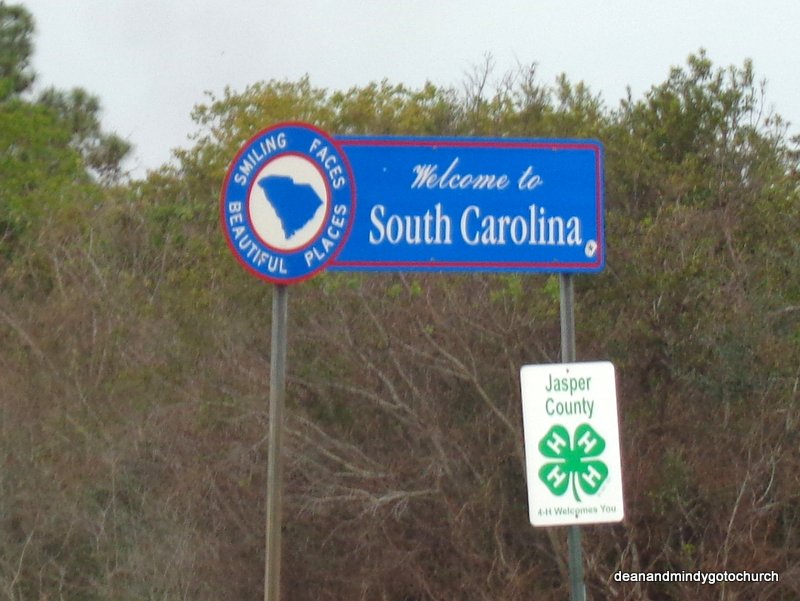
6 (somewhat) surprising facts about South Carolina


 Don't tell anybody, but instead of staying completely in one state this week, we've been on the border between North and South Carolina, going back and forth multiple times a day. We'll officially cross into North Carolina this afternoon, so for now, let's pretend we've been in South Carolina every minute of the past week.

1. The state foods are peach, collard greens, and boiled peanuts.*

2. Lake Wylie, a 13,400 acre man-made reservoir, is the state's 8th largest lake**

3. The first European settlement (it was led by a Spaniard, Lucas Vazquez de Ayllon) on the North American continent may have been in what's now South Carolina, founded in the fall of 1526.*** The community was abandoned after about three months due to illness and harsh winter weather. However, the settlement lasted long enough to hold the first Catholic mass on North American soil; two Dominican friars were among the settlers.

4. When the English colonized what's now South Carolina, the Low Country in the southern part of the state had very fertile soil and good harbors. Religious tolerance was another factor in the prosperity of the area. The colony was named in honor of King Charles I of Great Britain****

5. In 1776, South Carolina became a republic and elected a president. In 1778, South Carolina was the first to sign the Articles of Confederation, making it a part of what would become the United States. At the time, slaves were vital to the economy (and had made up half the population since at least 1708), which was dependent upon indigo and rice farming. The state was also the first to vote to secede from the Union in 1860.

6. The American Revolution was an opportunity for slaves to obtain freedom by running away to the British. An estimated 30% of slaves in South Carolina (about 25,000 people) fled, migrated, or died during those years. As a result of the Great Migration, in which many black Americans headed north in search of jobs and opportunities denied them in the South, the state had a white majority in 1930 for the first time since 1708.

*we did not eat any of these foods while in South Carolina. Oops.

**the border with North Carolina pretty much bisects the lake. I didn't look up how much of the total acreage is actually in South Carolina.

***then again, it might have been in Georgia, or near the Chesapeake Bay. Scholars differ, and the settlement's founder didn't leave clear notes. He died there, though, as did about half of the 600 settlers.

****Carolus is Latin for Charles. And if you know your English history, you realize that this is the king who was beheaded during the English Civil War.