Saturday, January 23, 2016

Homes for the homeless in Austin


"We're all about forming relationships here," Matt, the assistant property manager, told us when we asked about the purpose behind the permanent community that's taking shape on the western side of Austin. Through a slow but constant process, a ministry originating in 1998 with five men who wanted to love their neighbors has become much more than a minivan loaded with food.

Mobile Loaves & Fishes now has a fleet of modified catering trucks that serve food, clothing, hygiene items, and other life sustaining material to homeless people in Austin and other communities. In a quote on their website, Alan Graham, a founder and now president of the organization, says, "Everything we do is about relationships. The biggest lesson we have learned over the years is that we are not a food ministry. We merely use food as a conduit to connect human to human and heart to heart."

Community First! is one of a number of Mobile Loaves & Fishes' projects. Their website describes the village as "a 27-acre master-planned community that will provide affordable, sustainable housing and a supportive community for the disabled, chronically homeless in Central Texas." From that description, I would have pictured cinder-block buildings in tidy rows with (perhaps) a community garden and a recreation room. That's not at all what we found.

As we drove up, the first things we noticed were enormous teepees. Later, we found that these were bed and breakfast spaces for volunteers. Dean immediately noticed the large movie screen, which (through Alamo Drafthouse) will be used for free outdoor movies for the community.

As we walked around, we saw the mobile home park, the oldest part of the community. Across the center road, past a central area with a dining tent, gardens, chickens, a giant chess board, and a memorial marker for residents who have died, miniature homes and canvas cottages face meandering paths. The variety of homes is remarkable. Matt told us there were several models, but it seemed no two were identical, although all of them were attractive. Homes were at all stages of completion, and workers were everywhere.

This is not institutional housing.

I think my favorite moment was when we passed a house that was built, but didn't yet have its siding in place. The pine walls were covered with handwritten Bible verses of blessing, conveying the hopes and prayers of the builders for the future residents of the home. Matt told us that whenever a resident moves in, there's a blessing ceremony, welcoming the new resident to the community. 

He told us there's a kind of community on the street, but when people are moved into housing in an existing community, sometimes the former homeless person feels ostracized, in part because they've lost the community they've had. That's why, he said, "we're all about forming relationships here."

The community is designed to serve people whose housing needs have no other way of being effectively met. Except for ten "missional" families who live on site, the residents of the community have been chronically homeless (for at least a year in Travis County) and must have an assessed disability. All residents agree to abide by three rules (these rules are detailed in agreements that each resident signs before becoming part of the community).  Basically, each resident agrees to obey civil law, pay rent, and obey community rules.

The community also includes a medical clinic, an art studio, extensive produce gardens, goats, beehives, chickens for meat and eggs, and a smithy. The entire community has internet. The micro-homes and canvas cottages rely on shared kitchens and bath houses within 150 feet of their doors. Each resident has his or her own secure space for keeping food in their kitchen. There are currently two chapels, where residents and volunteers can pray or, if they want, "yell at God," Matt said. Soon, a new building with offices, creative spaces, a computer area, classrooms and a sanctuary for worship services will be built near the center of the community.

Churches and faith-based organizations have obviously been involved in the project since the beginning.  I wondered if the word "goodness," which was present on various signs all over the property, was a kind of code name for God's activity. After spending time at Community First! Village, I think it probably is.


Tuesday, January 19, 2016

Eldorado Community Church, Santa Fe, New Mexico

Every seat had a box with a label reading "Please do not open until instructed to do so." During the sermon, Pastor David told us to open our boxes. He asked us what we found. Most people called out "a paratrooper" but I said, "Pooper Trooper" because that's what we always called the toy when we were kids.

Mindy and I had arrived for the fifth (and last) Sunday of a sermon series entitled "Elements," which explored what we need to be a follower of Christ. We missed "Earth" for Christian Character, "Fire" for Communion, "Wood" for Connection, and "Water" for Community, but we were there for "Wind" for Commission. Acts 2 and John 3 were used for texts, both of which describe the Holy Spirit with the image of the wind. The toy was a reminder that just as the wind directs the plastic parachute, we must rely on God for direction.

Pastor David McPherson followed God's direction to come to Santa Fe to plant a church fourteen years ago. He had been attracted to the area for many years. As a young man, he had served at Glorieta Camps, just a few miles from the city. He and his wife, Melanie, had often vacationed in the area and had thought of retiring there. But they finally thought, why wait?

With some support from the Southern Baptist Church they came to the community of Eldorado, about about eleven miles from the Santa Fe plaza. There was not an evangelical church in a ten mile radius from the Eldorado Community Center, and a decade and a half later there still is only one other church in the area, Saint Elias the Prophet Greek Orthodox Church.

David spent the first year talking to people and listening to what they were looking for in a church. And that first Sunday, there were sixty people; very encouraging. And the next week there were twenty people, and in upcoming weeks there were less. But the church persevered.

Santa Fe is not exactly the Bible Belt. The area attracts a unique demographic which partially explains why the church strives to be a "community of grace and hope for searchers, dreamers, rebels, artists, losers and adventurers." David described the congregation as having a variety of backgrounds, "Muslims, Buddhists -- we recently baptized a young woman who was raised as a Pagan." Most of the people we met seemed to have a Christian background, but David admitted that in the recent past the church has become a bit more "churchy."

We were introduced to the church by our friend, Mary Southall, who we knew from the Healdsburg Community Church. For much of her life she had been repelled by the church, having grown up with a father who said she should go, but didn't live up to it himself. About ten years ago she happened upon Healdsburg Community Church, and when she moved to New Mexico she hoped she would like this Community Church as well. She soon integrated herself into the church. That morning, she made and brought the snacks; she also leads a weekly Life Group in her home.

Pastor Dave wouldn't call her a member of the church, though. The church doesn't have members. Once people have attended for a while and decide to step up their commitment, they can become volunteer staff. And volunteer staff vote on important issues in the life of the church.

A group of interns from Glorieta also help out. We met Jake, who leads the music. He works part time at the church and part time at the coffee shop that shares the building with the church. (Other storefront neighbors include a fitness center and a Bernie Sanders volunteer office.) Another intern co-ordinates volunteers, while another leads the children's ministry (KidZone); ECC provides housing, utilities, and a small stipend; all interns must find other part time work.

Pastor Dave does other work himself. He is a professional potter, specializing in Raku, selling his work in the area. His wife, Melanie, just recently took over a different business. Last December they bought a bakery in downtown Santa Fe called Sweet Lily. It was a dream come true for Melanie, who has worked a baker for years.  Last Friday, we met Dave at the bakery, and he was manning the cash register. I asked how they handled balancing the church and the bakery, and he said they were still figuring it out.

David seems quite willing to admit that they haven't figured out how church in general should be done. He says the way they do things is continually changing, and if you like how they do things now; realize it might all be different next year. In Sunday's sermons, he challenged the congregation, if they were Christ followers, to not think of church as a place for their comfort and entertainment, but instead as God's instrument for caring for a hurting world.

I trust God will continue to direct and use ECC to care for the needs of hurting folks in Santa Fe, as their Sunday morning handout says, "We welcome those who are single, married, divorced...filthy rich, dirt poor...You're welcome if you're 'just browsing,' just woke up, or just out of jail." In short, they aim to welcome everyone; as God is directing them to do.

Statistics:
Service Length: 50 minutes       
Sermon Length: 32 minutes
Visitor Treatment: Our friend Mary introduced us to a number of people, and several others introduced themselves. The handout contained a tear-off sheet for visitor information (as well as space for prayer requests and updates of regular attenders' information). As instructed on the sheet, I placed ours in the offering box on a table to one side of the room.
Followup by Tuesday Morning: none
Our Rough Count: 45
Probable Ushers' Count: 55
Snacks: coffee, tea, decaf, water bottles, cookies, frosted muffins, brownies
Musicians: 2 men on guitar and vocals, one man on percussion, 1 woman vocals
Songs: "We are Here for You"
            "How Deep the Father's Love"
            "Revelation Song"
            "Nothing but the Blood"
Miles to church: 5 miles
Miles from start: 1,379
Total 2016 Miles (to New Mexico/Texas border): 3,127


Monday, January 18, 2016

6 things you ought to know about New Mexico

1. New Mexico has the highest percentage of Hispanics of any US state and the second highest percentage of Native Americans after Alaska

2. Oddly enough, New Mexico has had its name longer than Mexico has. Early explorers first called the area New Mexico because they believed the population to be like the people of the Aztec empire (also called the Mexica empire). The nation of Mexico wasn't called that until the 1800s. The city of Santa Fe was established around 1608, but there appear to have been human communities in the state for the past 11,000 years

3. The state has very little surface water; the landscape includes mesas, deserts, and snowy mountains. The climate is mostly arid or semi-arid, with only 13.9 inches of precipitation per year. A major oil discovery in 1928 made Lea County (and by extension, much of the state) more prosperous

4. The state bird is the greater roadrunner, but the state mammal is not the coyote. It's the black bear
  
5. Both Confederate and Union forces claimed ownership and territorial rights over New Mexico. The Battle of Glorieta Pass, fought southwest of Santa Fe, decisively broke Confederate power in 1862


6. In 2015, over 51% of the population was born in New Mexico. Almost 29% speak Spanish at home, while about 4% speak Navajo. In 2008, the state officially adopted a Navajo textbook for use in public schools. The state flag reflects the heritage of the state's people, with the gold and scarlet colors of the flag reflecting the royal standards of Spain, and the sun symbol of one of the ancient peoples of the area, the Zia (a tribe related to the Pueblo) 

Saturday, January 16, 2016

4 New Mexico churches (and a former church) we only looked at

We couldn't make it to services for any of these churches, but we did have an opportunity to enjoy their beauty.

San Felipe de Neri in Albuquerque.


San Miguel Mission in Santa Fe, the oldest church in the United States.


The Cathedral Basilica of Saint Francis of Assisi in Santa Fe was built in 1869 and 1886 on the site of an old adobe church, La Parroquia.  Sadly, the Prayer Garden was locked.


Saint Elias the Prophet Greek Orthodox Church in Eldorado at Santa Fe is one of only two churches in this small community. We saw a sign announcing that the icons could be viewed on Thursdays from 11:00 am to 1:00 pm. We arrived at 12:50 pm, and everything was locked up.


(yes, Dean rang the bells. Mindy was shocked and appalled)

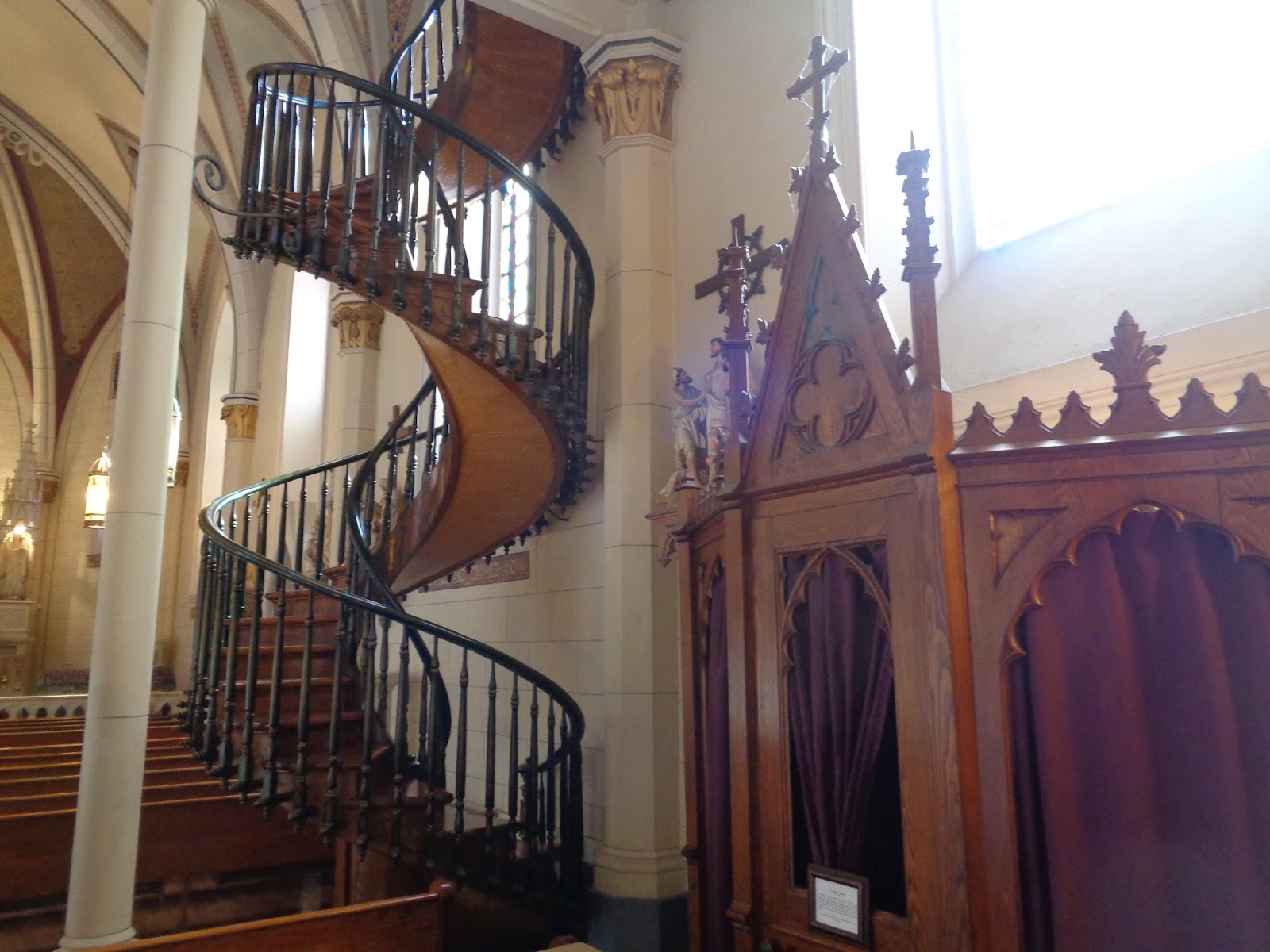
The Loretto Chapel in Sante Fe. It is no longer a church, but rather a tourist destination, as the sisters of San Loretto sold it to private ownership in 1971.


Friday, January 15, 2016

Big fun with missionaries and volunteers -- SIL Mexico Branch

When our friends Larry and Linda offered to give us a tour of Larry's workplace, we said yes. When they said we could be there for devotions with the snowbirds who had just arrived for their winter of volunteer work, we could hardly wait for Monday morning. We were going hang out with some of our heroes: missionaries, retired missionaries, and people who volunteer to help missionaries.

The building where we met is one of several that make up the SIL Mexico Branch facility. A few minutes before 8:00 am, people, mostly retirement aged, began to gather in a meeting room lined with blue, yellow and green banners. New Testament into a language spoken in Mexico. The translators' names and date of completion were on the banners as well. Yellow banners represent languages which are currently being worked on. A dozen lime-green banners hang on either side of the stage. These are languages which don't yet have any part of the Bible, and on which no SIL translators are working. By 8:00, most of the seats were filled with volunteers or missionaries working from the Mexico Branch headquarters.The blue banners -- by far the largest group, reaching across the back of the room and all the way up one side -- represent completed translations (sometimes with a revision) of the

The devotional time began with a song, "The Family of God," which everybody seemed to know (the woman leading mentioned that it was sung every morning), followed by a reading of Psalm 27:4. After that, we sang "Great is Thy Faithfulness, one of my favorite hymns ("all the verses!" the leader said). When we finished singing, she gave us an assignment: write our own fourth verse. I've been pondering this since then, but haven't yet written it.

Linda had been excited to hear from the speaker, hoping he would share his own story, which would have been wonderful. Instead, he gave an update on some of the changes at the SIL Mexico Branch since the last time the volunteers were all together (in the spring of 2015). The information he gave was helpful and encouraging, especially for helping incorporate new volunteers with veterans. He finished by saying, "God bless you! Go to work!"

When the devotional time ended, the room cleared quickly as people headed for their work areas. We headed down a hallway lined with clothing and other everyday items from life in various parts of Mexico over the past 75 years or so. I wanted to see the sewing/quilting group, Dean wanted to see the computer building he'd seen a sign for, and Linda wanted to show us the stamp room.

The volunteers in the sewing room were just getting started. They mend clothes for the missionaries and make quilts that are sold to raise money for translation work, among other projects. Since it was the beginning of the first day, the volunteers were still getting their winter's work organized, so after a couple pictures, we headed on.

As we walked to another building, we passed two men discussing the deck-building project at Larry and Linda's house. Since they weren't entirely sure how to get there, we all drove back to the house together, postponing the rest of the tour until later in the day.

Before long, the volunteers had torn off half of the sagging deck previous owners had built (badly) outside the dining room. Once it was down, they asked if Dean would mind whacking down a particularly nasty weed called cats' claw that had grown up under the deck. He welcomed the opportunity to get some exercise. Before long, we were able to head back to the offices to resume our tour.

We arrived just after the morning break, and found the stamp room after a question or two. There, volunteers sort donated postage stamps for sale to collectors. This project has raised a surprising amount of money for the ministry each year (I forgot to write down the amount, but  I know it was more than $1000.00). Then we set off to find the computer building.  Linda didn't remember that there was anything more than an office with one IT worker who supports all the missionaries and projects SIL has in Mexico, but we asked around and soon found ourselves outside a room with one guy, a lot of equipment, and a tiny museum of computer history. The phone rang several times in the few minutes we were there, but we got a quick explanation of his work. We were impressed (as we have been other times) by how much computers have improved the life and work of missionaries. We also had a quick tour of the repair shop and the area where furniture is reupholstered to extend the life of donated (or just old) items. We also got to visit the boutique, which is a kind of thrift shop where missionaries can share standard thrift-store type items.

I've loved and supported SIL missionaries since college, so the opportunity to visit them at work was fantastic. The base of volunteers who support missionaries in non-financial, practical ways, donating their time and having fun while they're doing it, is a whole other set of heroes to emulate.

Statistics:
Service Length: 47 minutes
Sermon Length: 18 minutes
Visitor Treatment: first time volunteers were asked to stand and give their names (and where they came from).
Our Rough Count: 77
Musicians: maybe piano? I forgot to notice, but I'm pretty sure we didn't sing a capella
Songs: Family of God
            Great is Thy Faithfulness
            Happy Birthday