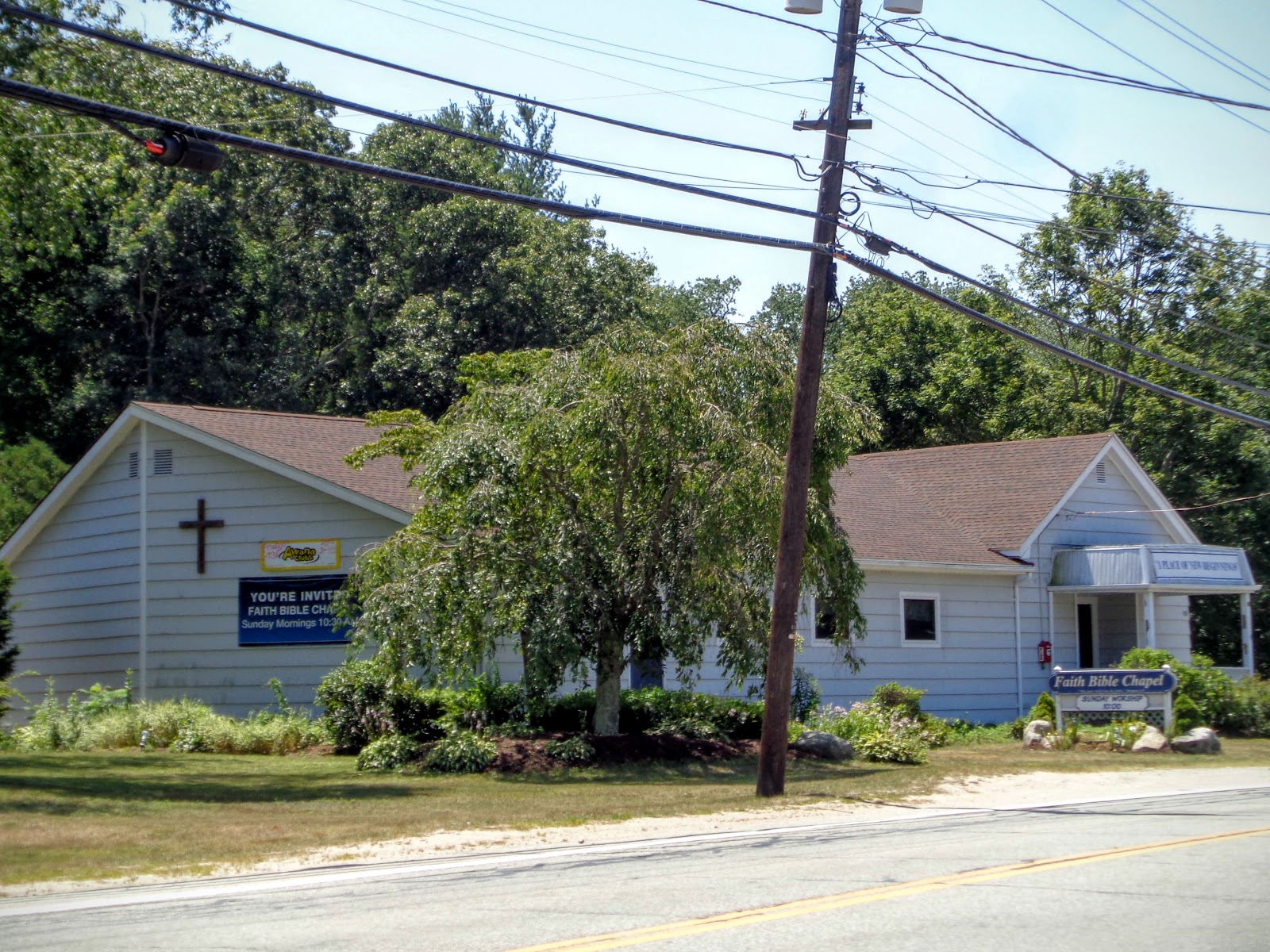
“Can I ask you, Jay, how you manage to smile and sing at the same time?” Carol asked the pastor’s wife at Perryville Bible Church in Wakefield, Rhode Island. Sadly, the question remained unanswered for the time being, because Pastor Jim Menzies suggested the question could be answered at another time.
Carol asked her question during the pass the mike prayer time, which not all churches can have. A megachurch that has thousands of people in a attendance can’t open prayer time for everyone to share a prayer or praise -- unless everyone is willing to give up sleep and the upcoming work week. Some clergy might be concerned about passing a mike if they don’t really know the people in the congregation. Perhaps some will have a prayer concern about alien space invaders or have a praise for successfully evading income taxes. It’s something a megachurch executive pastor or administrative pastor would prefer to avoid.

I understand why many churches can’t have such time in weekly worship services, but I appreciate it when they do. I’ve always appreciated being in a small congregation when everyone is offered an opportunity to bring their concerns and moments of celebration before the Lord. When I was growing up, my church offered such times, and the church in which I last served did as well. Sure, sometimes you heard more about the ailments of great aunts than you really were able to muster interest in, but sometimes you were able to share in the most rich and difficult times of the lives of brothers and sisters in Christ. (And for the health of individuals and the congregation, people need to have the opportunity to share this way, whether through Sunday School or small groups.)

Anyway, during the open mike prayer time this week, a woman expressed thanks for the church itself. She’s a summer visitor who has come to Perryville Bible Church each summer for fifty years, since the days when the church met in a building that’s now a house, back when it was called Perryville Baptist Church (the name was changed because of the concern some visitors might be shy of the Baptist label).
Perryville is a church that takes prayer seriously, and that’s a reason we chose to go there. We were in the neighborhood because we were staying in the Burlingame State Park. A little internet research showed that Perryville Bible Church had a Wednesday night prayer meeting.
We went Wednesday night and found over a dozen people gathered (mostly older than we are). We were welcomed heartily, and led by Pastor Jim, people asked us many questions about our trip.
I appreciate it when people show a genuine interest in our travels, and it’s not solely because of narcissism (though that surely plays a part). I think it’s a healthy thing in a church to be curious about what God is doing in other parts of the Church.
Many churches that have Wednesday night prayer meetings don’t actually take much time to pray. Often, teaching takes the bulk of time, and prayer is tacked on at the end. At Perryville, the usual practice is to read a passage of Scripture (I Cor. 13 that night), and then people were encouraged to pray in response to that passage. People were asked to share requests, and the majority of the time was used to pray. The prayer time was wrapped up promptly at the end of the hour.

Jerry Seinfeld used to do a very funny bit about his father watching CNN. He talked about how his father watched hour upon hour of news about international affairs, and the comedian wondered what good it would do. Would the State Department someday phone his father begging, “Mr. Seinfeld, a planeload of diplomats just went down and now only you have the knowledge to negotiate this treaty with Zambia!” The night we were at Perryville’s prayer meeting, a woman brought up the recent chaos caused by an attempted coup in Turkey and the government crackdown that followed. She expressed concern about missionaries and the work of the church in the country. She asked people to remember the region in prayer.

It is a true and amazing thing that as absurd as Seinfeld’s joke makes it seem, when we pray, we play a part in global affairs. As the Psalmist wrote, “By awesome deeds you answer us with righteousness, O God of our salvation, the hope of all the ends of the earth and the farthest seas.” (Ps. 65:5)
We had another opportunity to pray on Friday morning, when a small group of women gather at the church each week to pray. One of the women, Lucy, asked for prayer for a “transition house” being established in Haiti for orphans who, by law, have to leave orphanages after they turn 18. The “transition house” is for young adults who aren’t yet ready for life entirely on their own. Lucy is involved in Haitian orphanages through a nonprofit she started, Helping Haiti's Orphans. She visits the country regularly and obviously has a passion for the Haitian people.
At both prayer meetings people expressed concern for our country and the upcoming elections -- without expressing support for any particular candidate or party. There were flyers and posters in the church for Franklin Graham’s Decision America and the upcoming prayer rally August 31st on the Capitol steps in Providence.

We attended the adult Sunday School class, which is beginning a series on the book Everyday Theology (Cultural Exegesis): How to Read Cultural Texts and Interpret Trends edited by Kevin J. Vanhoozer. The discussion of the morning was about what current trends in funerals and mourning might have to say about the spirituality of the culture. (There was some discussion of Kane Kwei’s Carpentry Workshop, where coffins shaped like fish, shoe, cars, airplanes and a great many other designs are available.) There was an interesting discussion about whether the methods of burial in the Bible are just descriptive or prescriptive. (We’ve been to a fair deal of Sunday School classes this year, but I can firmly state that this was the first class I attended were we saw a picture of a coffin shaped like a chicken.)

The sermon of the morning was on a more conventional topic. Pastor Jim was beginning a series through the book of Mark (“Mark is the shortest Gospel, which is no indication of how long the series will last,” he told the congregation). The focus of the sermon was the nature of Christ, and I appreciated his use of the Easy to Read Version of the Bible for the opening verse, “The Good News about Jesus, the Messiah, the Son of God, begins.” (Mark 1:1)
After the service. I asked a few regulars what they appreciated about Perryville Bible Church. Several mentioned the church’s faithfulness to Scripture. Sharon, a woman looking after several young children, said, “I’ve always been here and there’s no reason to leave. I know everybody. The Bible is taught and as long as that happens I’ll be here.”
The Bible is taught. People pray. Sometimes that’s enough.
Statistics
Sermon length: 26 minutes
Service length: 1 hour 5 minutes
Visitor treatment: There was a greeting time during the worship service. Visitors were welcomed, though not singled out. Mindy found a visitor/change of address card in the back of the chair in front of her (and she saw them in other rows as well), so she filled it out, although there was no mention of them in the service. Visitors seem to generally come year after year when they’re in the area on vacation.
Our rough count: 48
Probable Ushers’ count: 55
Snacks: coffee and hot water for tea
Musicians: keyboard (man)
piano (man)
vocals (3 women)
Songs: “As we Gather”
“All Because of God’s Amazing Grace”
“Amazing Grace”
“Doxology”
“Amazing Grace” (keyboard and piano offertory)
“At Calvary”
“Amazing Love”
“The Gospel Song”
Distance to church: 10 miles
Miles from start: 33,248
Total 2016 miles: 32,952
Church website: http://perryvillebiblechurch.org/Joomla/