Showing posts with label Ohio. Show all posts

Thursday, September 1, 2016

We go to church in Ohio...or is it a bar?

Black Cloister, Toledo
It hasn’t been unusual, when we ask people at bars what makes for a good church, to hear, “the church should serve beer.” And, when we say we’re going to a bar and a church in every state, people have occasionally thought we said we were going to a bar in a church in every state.


In Ohio, we finally went to a place that is both a bar and a church, although the two functions don’t overlap. Every day of the week Black Cloister is a bar, but on Sunday mornings, before the bar opens, the space is also home to a church. Unlike a few other churches that hold worship services or Bible studies in bars, there’s quite a connection between the two entities. Tom Schaeffer is both lead pastor of Threshold Church and CEO, GM, and Marketing Brewmaster of Black Cloister Brewing Company.


We visited twice; on Friday night we stopped in Black Cloister for drinks, and on Sunday morning, we came to the same address for worship with Threshold Church.


On Friday night, Toledo was a lively place. The pub is within blocks of a strip club (which had a pathetic sign advertising “college scholarships” for dancers) and, more happily, within blocks of the Mud Hens Baseball Stadium (we were able to walk into the stadium without a ticket in the 9th inning, and the Hens were winning). There were a lot of people in the streets, and there was a good crowd in the Black Cloister.


We went with our new friends from Mosaic Ministries, David and Kelly. David had a beer, Kelly had a white wine spritzer, Mindy had rose, and I had a pineapple cider. Sadly, David one among us who’s a fan of beer in this place that celebrates the art of brewing.


Martin Luther gave Black Cloister, Toledo, his blessing
The pub is decorated with Reformation-era themed art and signs. Martin Luther was a fan of beer (his wife, Katie, the former nun, was the brewer in the family) as well as a theologian, so he fits in happily at the pub and the church, which is affiliated with the Evangelical Lutheran Church of America. A Kickstarter campaign was used to start the Black Cloister, and a banner on the wall honors the “95 Heroes” of the campaign (echoing Luther’s 95 Theses nailed to the Wittenberg door which kick started the Reformation).


It’s second nature to us now to ask our two bar questions when drinks are in front of us, so we asked David and Kelly, “What makes for a good bar?” and “What makes for a good church?”


Kelly answered that at a bar, “I hope for a wide variety of drinks, because I don’t like beer but I want to try different things. I want to come with friends and be able to talk. I’m not looking to meet new people.”


David said he appreciates “the ability and willingness to make a good Mojito. Lots of bars won’t make one or use a bad mix.” He also likes creative mixed drinks with clever names.


As for a church, Kelly said she looks for “vulnerability. It should be okay to be different and have issues and not be shamed. People should be allowed to have problems.” She said she’s been to churches where people are clean on the outside but not inside. I was reminded of Jesus referring to the Pharisees as “whitewashed graves.”


David said worship is important, because that is what we’ll spend doing forever. He said the “worship should draw out the heart and draw people closer to Jesus.” It should teach the Word, making “self-supporting disciples rather than dependents.” There should be “grace and joy in expressing the love of Christ.”


On Sunday at 11:00 am, we returned to Black Cloister with David and Kelly for worship. No beer was being served (on Sundays, the bar opens at 1:00 pm), and children were present. Coffee, water, orange juice and hot water for tea or cocoa were available, along with muffins and coffee cake. A number of people greeted us, including Pastor/ Brewmaster Tom. We weren’t the only “media” people present. A local photographer was taking pictures for Living Lutheran.


I met a couple, Dave and Kylie, before worship began, and asked them what they like about this church. Kylie answered, “God’s here. It’s a happy place. It’s a community.”


Dave responded, “Tom’s a good teacher. And the church is missional-based, concerned for reaching out. It’s not judgemental.” They’ve attended the church for ten years through four different moves, including a time when they were meeting in people’s backyards.


The service began, people took their seats at tables, and we sat at the bar. During the announcements, people were invited back to Black Cloister for Table Talk on Tuesday night, a time of “fun and fellowship.” People were reminded of Trivia Night at the pub, noting that people from the church “win more often than not.” And there was an announcement for a “Leadership Huddle” right after the worship service.


The sermon was the third in a series on the Lord’s Prayer. (The sermon notes handout uses a hexagon for note taking. Apparently Tom likes to use geometric figures to illustrate theological points.) He spoke about the section of the prayer that is a request for daily bread. Speaking of God’s provision, he referred to the story of Abraham’s (near) sacrifice of his son Isaac. (“It’s a brutal, crazy story, there’s no denying that.”) The basic point of the sermon was “being in relationship with God means you know He will provide.”


During the prayer time after the sermon, people were urged to stand and give either their request or their praise. The congregation responded with either “Lord have mercy” or “Let us bless the Lord.” The Lord’s Prayer concluded the prayer time, followed by Communion, with all who trust Jesus for salvation invited to the Lord’s Table (the gluten-free alternative was served first). Mindy and Kelly both commented on the quality of the wine and bread.


As we sang the closing chorus, a bartender quietly signed in and began setting up for the pub’s 1:00 opening.


After the service, I had a chance to talk with Pastor Tom about both Threshold and Black Cloister before the leadership huddle. I asked him about the strengths of the church. “We moved four times, and that taught us not to rely on the building,” he said. The church first met in a nightclub, the Omni, but shoes sticking to the floors (among other things) proved a problem.


The church is very mission oriented. “Though we’re small, when we do a missions project, everyone shows up.” They’ve been involved with Just Pancakes, which serves over 3.000 pancakes every Saturday morning. Threshold has also served with Food for Thought.


I asked about the challenges of being a church that meets in a bar. He said that people in the congregation had urged him to start the brewing company, and before they began, held a town hall meeting with other Lutheran churches in the area. The other churches voiced their concerns, but eventually, they agreed to disagree. Overall, Tom believes the downtown location provides great opportunities for ministry.


Then I asked about Black Cloister. Tom said he believes that, ideally, every business and organization should seek to make the world a better place. At Black Cloister, they do try to do that:  a portion of the profits from one of their brews goes to the families of fallen firefighters.


He said the staff of the pub often joins in with the church on service projects. Once, when an employee heard about a formerly homeless person who’d gotten an apartment, the rest of the staff worked together to furnish the new home. No wonder a local publication gave Black Cloister the award for best bar staff, along with best bar. And the best beer for nerds.


I asked Tom about the challenge of handling alcohol responsibly, since obviously what happens at the pub can reflect on the church. He said they train the staff to avoid “over serving” guests. They call taxis for guest when needed (though he noted that state law prohibited taking people’s car keys). They serve liquor, but only top shelf, expensive brands, which makes shots less of a thing. Their “mug club” has “Rules of the Order” based, to some extent, on the Benedictine Rules of Order. Among other things, it explicitly encourages responsible drinking.


We left Threshold Church as the building was morphing back into Black Cloister; a church and a bar, both seeking to make the world a better place.


Statistics
Service Length: 58 minutes
Sermon Length: 20 minutes
Visitor Treatment: we were greeted by more than one person on arrival; there’s no record of attendance that we were aware of
Followup by Tuesday Morning: none
Our Rough Count: 32
Probable Ushers' Count: no ushers
Snacks: coffee, cold water, hot water for tea and cocoa, orange juice, muffins, coffee cake (the bar was open after the worship service, but we didn’t notice anybody ordering)
Musicians: acoustic guitar (man)
Vocals (2 women)
Songs: “Meet with me”
“Breathe”
“Your Great Name”
“You are my King/Amazing Love”
“Hand that Holds the World”
Miles to church: 7
Miles from start: 36,034
Total 2016 Miles: 35,738

Wednesday, August 31, 2016

8 Ohio churches (and a question with a prize!)

Anointed Gates Church, Collinwood Village, Ohio
Anointed Gates Church, Collinwood Village

New Life Cathedral, East Cleveland, Ohio
New Life Cathedral, East Cleveland

Linden Life Fellowship, Columbus, Ohio
Linden Life Fellowship, Columbus

Calvary Baptist Church, Findlay, Ohio
Calvary Baptist Church, Findlay

Buckeyes for Christ, Columbus, Ohio
Buckeyes for Christ, Columbus

Evangelical Church of the Sanctified and Lighthouse Christian Academy, Columbus, Ohio
Evangelical Church of the Sanctified, Columbus

First Presbyterian Church, Maumee, Ohio
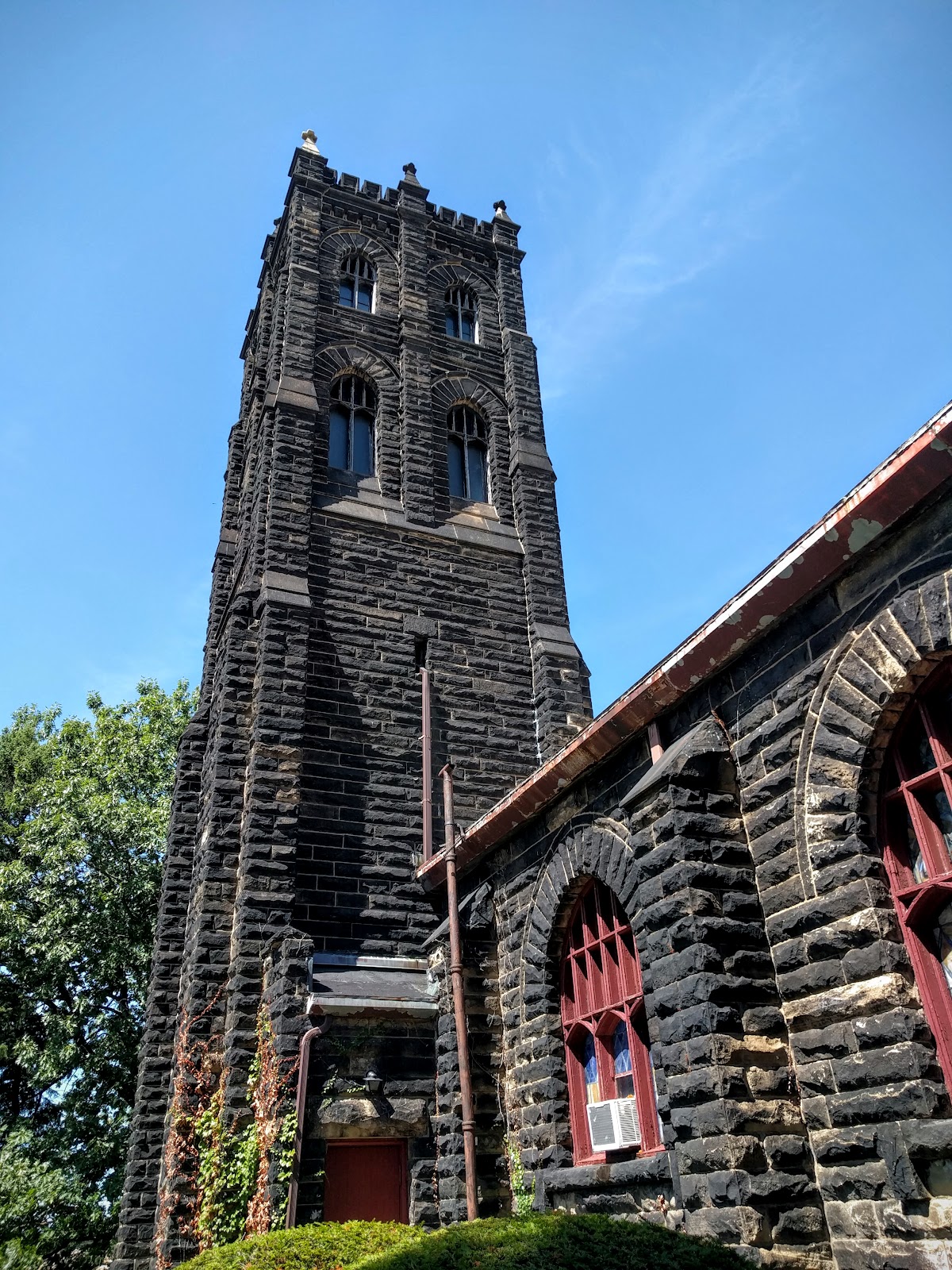
First Presbyterian Church, Maumee

St Paul's Lutheran Church, Maumee, Ohio
St Paul's Lutheran Church, Maumee

Win a prize! In which of these church buildings did Mindy hide under the pews? Make your guess in the comments or on Facebook. If your answer is correct, we'll send a postcard to whatever address you provide

Tuesday, August 30, 2016

Mosaic Ministries, Toledo, Ohio

As the tuition prices of major universities continue to spiral upward, the good news is that Baby U is still free. In fact, people are paid to attend, with such incentives as diapers, formula, clothes, books, and gift cards. I assure you, BU is a real place, unlike PU, which is not.


When our children were young, we told them that all we knew about parenting we’d learned from Parents University. If we did anything wrong as parents, it was obvious that Old PU was to blame. Occasionally, we let it slip that our grades at PU weren’t the best and perhaps one of us didn’t actually complete our course of study. Our kids now say they knew we were joking, but back in the day I think they might have bought into it.


Amusing stories from our past aside, Baby University is real. It is an outreach of Mosaic Ministries in south Toledo, Ohio, with the goal of educating new parents and parents-soon-to-be in life skills, child rearing strategies, nutrition, and other important topics and skills. Mosaic ministers with the very poor local residents, many of whom have never had or witnessed examples of good parenting.


Low income children enter school with many disadvantages. Studies show they are behind middle class students in learning development by sixty percent, a margin that is difficult, if not impossible, ever to overcome. Baby U tries to encourage parents to bridge that gap with such simple steps as reading to their children for as little as 15 minutes a day.


Baby University is the beginning of Mosaic’s “Transformation Pipeline” for kids and adults. Mosaic has begun a partnership with the Toledo Day Nursery, one of the nation’s oldest preschool entities (established in 1871). Soon there will be preschool classes on the Mosaic grounds. Another important ministry for kids is the Beauty Project that teaches pre-teen and young teen girls that they are more than their outward appearance. For others, the ministry also helps people obtain their GEDs, and this fall there will be a class on finances for adults.


But if all Mosiac did was provide educational opportunities, that wouldn’t be nearly enough for the director of the ministry, Pastor David Kaiser or for his wife, Kelly, who’s the director of Baby University. Their primary mission is to see a spiritual transformation of the community through the Gospel of Jesus Christ, so worship and Bible study are vital ministries of Mosaic.


We were able to attend both a Tuesday night 5:30 worship service and the 5:00 pm Sunday worship service. Both services are followed by meals and a grocery distribution. Some people certainly come for the food, but some certainly did not. One young woman explicitly said, “I didn’t come for groceries.”


Pastor David asked, “Did you just come for Jesus?”.


“Yes,” she said with a smile.


The Tuesday night worship was conducted by folks from a nearby Methodist church. Sunday’s service was conducted by long time friends of the ministry. Though Mosaic is under the auspices of the Southern Baptist Church, many different denominations contribute to the ministry. The current building was purchased by Presbyterians. We talked with the pastor of a Lutheran church who had sent volunteers. The ministry has a broad base of community support.


On Tuesday nights, there is a Bible study following worship and the meal. Men and women meet for separate studies, and I (Dean) I went to the men’s study, where we talked about the importance of studying God’s Word. (Chris, the leader of the study said we need to “put our heads in God’s washing machine, the Bible”.)  


Mindy was impressed with the transparency of the women in her study who mentioned God at work while asking for prayer in difficult situations. One woman said, “God is freaking awesome.”


Tuesday and Sunday aren’t the only times food is available; breakfast and dinner are served throughout the week at Mosaic (or at another church, Vision, down the street, which several people mentioned attending as well). Mindy and I were there for a few meals, occasionally serving and sometimes just eating. There were parents with kids as well as couples and single men and women. Friends greeted each other and joked together. I chatted with one man who told me about his work landscaping during the summer and fall. I asked what he does in the winter, and he said he would do snow removal once winter gets started. A friend of his came and sat with us. (I was impressed when the friends exchanged an examination of each other’s arms, apparently to check for track marks. For people struggling with addiction as for the rest of us, that kind of mutual accountability is important.)


There are certainly struggles unique to this kind of ministry, and I talked with Pastor David about some of these. David had had a career in business before he took over this ministry (then called Western Avenue Ministries) in 2007. Previously, Pastor Don Bethan and his wife, Betty, had ministered to their community through the Western Avenue Baptist Church. When David came in, it became an independent ministry.


“This ministry isn’t for everybody. For instance, there was a five year old student that was sent out for testing for ADD. The results came back that the kid had STDs instead. If that doesn’t really upset you, Christ probably hasn’t called you to this ministry. But if upsets you so much that you can’t come back to work the next day… This ministry probably isn’t for you either.”


On Saturday afternoon, I went with Pastor David and representatives from a number of different churches in the area for a prayer walk through one of Toledo’s more notorious public housing complexes. I was told that one wouldn’t want to venture there alone or at night. We brought a cooler with bottles of water for residents and Otter Pops for kids. We would stop and chat with folks walking or sitting on their front steps. We offered to pray for people, and many accepted the offer.


I talked with a woman named Renita. She recognized David from attending a session of Baby University. I asked her what she had learned at Baby U. She said she learned it’s possible “to have a foundation for raising kids.” She said most people around her didn’t, but she wanted that for her kids.


I told Kelly about the conversation and she was glad to hear it. “Though I’d rather have heard she was reading to her children fifteen minutes a day.”


In this kind of work, it seems change comes slowly. But with God’s grace, it does come.

Statistics
Tuesday evening
Service Length: 24 minutes
Sermon Length: 9 minutes
Visitor Treatment: no distinction between visitors and regulars; we were greeted by name because we were expected.
Our Rough Count: 53
Probable Ushers' Count: no ushers (and we didn't hear how many got groceries or dinner)
Snacks: chicken, potato salad, roll and butter, water, Hawaiian punch (and a bag of groceries for those who wanted it)
Musicians: acoustic guitar (man), vocals (2 women), percussion box (man)
Songs: "As the Deer Panteth for the Water"
"Bind us Together"
"Get Down"
Miles to church: 327 miles
Miles from start: 35,761
Total 2016 Miles: 35,465
Church website: http://wamteam.org/

Sunday evening
Service Length: 58 minutes
Sermon Length: 22 minutes
Visitor Treatment: This time, they let Dean talk.
Followup by Tuesday Morning: We had dinner with David and Kelly after church, then breakfast the next morning, with some email correspondence about this post.
Our Rough Count: 55, with as many as 30 waiting in the hall
Probable Ushers' Count: 92 people signed in (some were individuals, and some were couples or families)
Snacks: again, dinner was served with groceries for those who wanted them
Musicians: acoustic guitar (man)
Songs: "Your Grace Finds me"
"Here I am to Worship"
"How He Loves"
"Amazing Grace/My Chains are Gone"
Miles to church: 5
Miles from Start: 36,034
Total 2016 Miles: 35,738
Church website: http://babyutoledo.com/

Monday, August 29, 2016

6 facts about Mindy's native state

Welcome sign at Ohio border near Lake Erie
1. The state motto, "With God all things are possible," is the only state motto taken directly from the Bible (Matthew 19:26).

2. Ohio has the 10th largest highway network in the United States. It's within a one-day drive of half of North America's population.

3. Eight Presidents considered Ohio their home state. Seven of them were born there, four died in office, two were assassinated.

4. Columbus, the capital, is near the geographic center of the (kind of) heart-shaped state.

5. Although the state takes its name from the Ohio River, very little of the river is within the state's borders.

6. Ohio's flag is the only non-rectangular state flag. It's a forked pennant with a stylized buckeye. Sadly, we didn't see it flying in many places.